

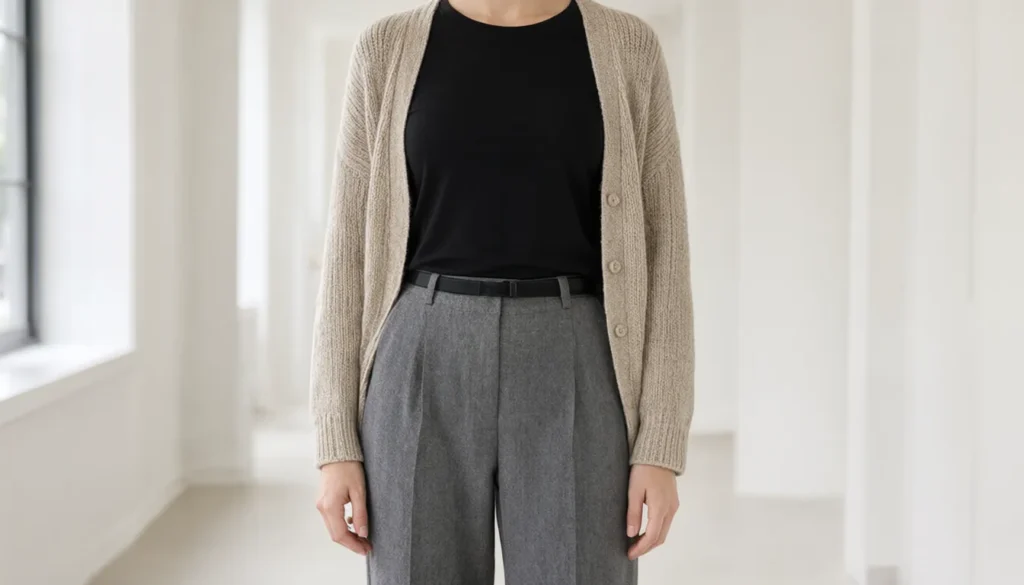
In cold weather the base layer is the one piece of your outfit you cannot take off in public. The coat comes off at the door, the scarf goes on the back of the chair, the cardigan can hang open by eleven o’clock, but the camisole, tank top or fitted tee against your skin stays on until you get home. That single fact changes how you should choose it. A base layer has to be right for the warmest room of your day, not the coldest street, because everything you add on top can be removed and it cannot.
This guide is about the three pieces most women already own for that job: the camisole, the tank top and the fitted T-shirt (plus the undershirt, which in British English is simply a vest). We make all three in our workroom in Bulgaria, and most of the questions we get about them arrive between October and February: which one goes under a chunky jumper, why a white shirt shows the strap of the tank underneath, why one top crackles with static under wool and another does not, why a tucked-in layer escapes the moment you sit down. We answer them with numbers where numbers exist, from the clothing-insulation tables engineers use to design heated offices, from a large body-measurement survey and from our own size charts, and with our judgement where they do not, labelled as such.
The short answer, before the detail: under a thick wool knit, a fitted long-sleeve tee or a wide-strap tank does the most work. Under a sheer or white blouse, a camisole in your skin tone. Under a buttoned shirt, a wide-strap tank or a short-sleeve fitted tee. Under a wrap dress or a V-neck, a camisole with a lower scoop than the neckline above it. Under a blazer, whatever matches the top you are wearing, because the blazer is the layer that comes off. The rest of this page explains why, and how to get length, fit, fabric and colour right so the layer stays hidden and stays put.
Camisole, tank top, undershirt or fitted tee: what each one is
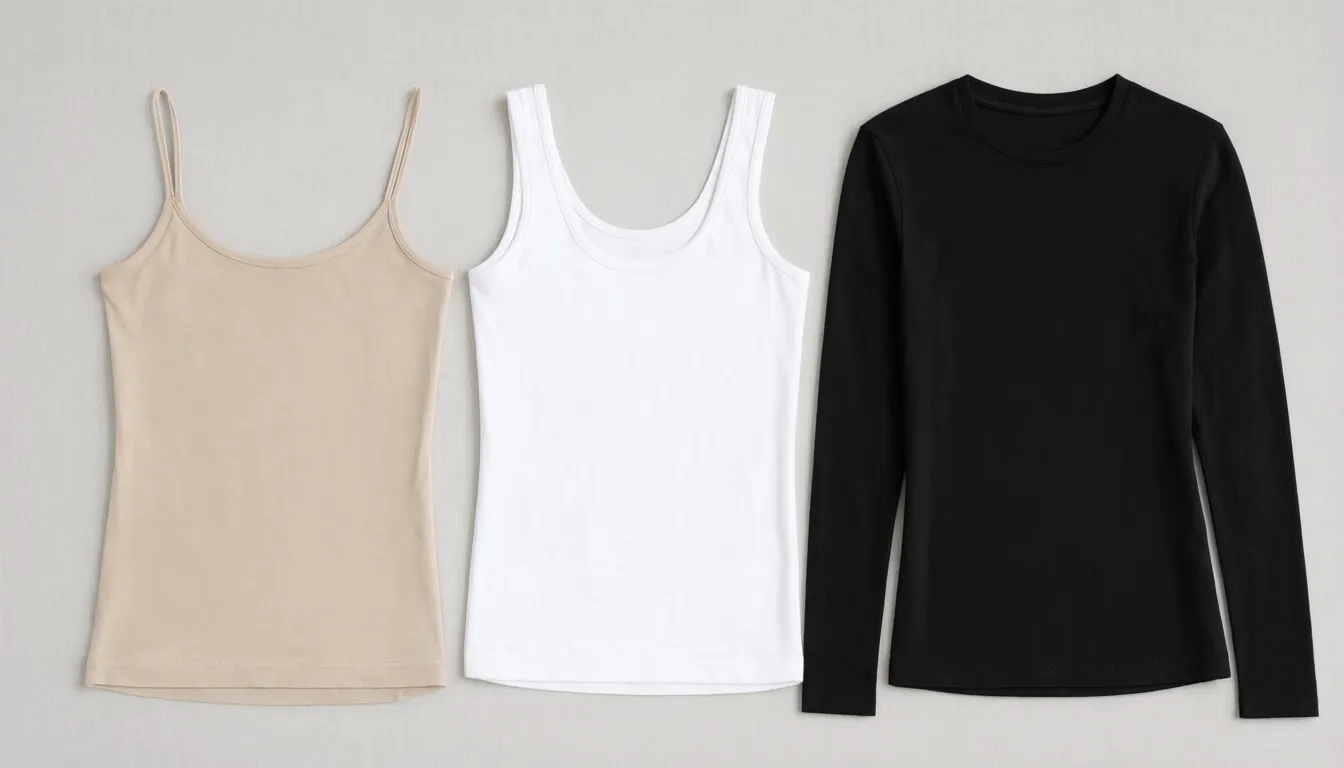
A camisole is a light top with thin straps, usually a few millimetres wide, and a scoop or straight neckline, made to be worn under other clothes. A tank top is a sleeveless top with wide straps that cover the shoulder. An undershirt (a “vest” in British English) is any plain top worn purely as an under-layer, sleeveless or with short sleeves. A fitted T-shirt is a close-cut tee with sleeves, short or long, that can be worn under a layer or on its own.
The words themselves cause half the confusion, because they change meaning between countries. In British English a tank top is traditionally a knitted, sleeveless jumper worn over a shirt, and a vest is the cotton under-layer worn for warmth; in American English the tank top is the sleeveless jersey top and the vest is a waistcoat (Cambridge Dictionary: tank top; vest). Most online shops, ours included, use the American sense, so on this page “tank top” means the sleeveless jersey top with wide straps.
The names matter less than a handful of physical features, and those are what decide where each piece can go.
| Feature | Camisole | Tank top | Undershirt (vest) | Fitted tee |
|---|---|---|---|---|
| Strap or shoulder | Thin strap, a few millimetres | Wide strap, covers a bra strap | Wide strap or short sleeve | Short or long sleeve |
| Neckline | Low scoop or straight edge | Scoop or round | Usually round or scoop | Round, scoop, V or mock |
| Armhole | Open, sits low under the arm | Close to the armpit; cut in on racerbacks | Close to the armpit | Set-in sleeve, no armhole edge |
| Typical fabric | Fine jersey, microfibre, mesh | Jersey, rib, microfibre | Plain cotton jersey | Jersey, rib, microfibre, mesh |
| Covers the arms | No | No | No (or upper arm) | Upper arm or whole arm |
| Best winter job | Lining sheer, white and low-cut tops | Covering straps, keeping knits off the skin | A plain warm layer under shirts | Warmth on the arms, smooth base under knits |
In our own range the four overlap more than the names suggest. Every one of our camisoles and tank tops has a scoop neckline and pulls on over the head with nothing to fasten; the difference between them is the strap. When we counted for this guide in November 2026 we had 18 camisoles and tanks you could buy, six with thin spaghetti straps and twelve with wide straps, in four fabric families: cotton (90% cotton, 10% elastane), microfibre and mesh (80% polyamide, 20% elastane) and a wool blend (22% wool, 70% viscose, 8% elastane). Our fitted tees come in round, scoop, V and mock necklines, five of the sixteen with long sleeves.
The weight of the fabric matters as much as the shape. A spaghetti-strap camisole in fine jersey weighs very little and adds almost no bulk under a fitted knit; a ribbed tank is thicker and grips better; a long-sleeve tee doubles the fabric on your arms, which is exactly what you want under a coarse wool jumper and exactly what you do not want under a fitted blazer sleeve. Keep that trade in mind: every gram of base layer you add is either doing a job or taking up room the outer layer needed.
What a base layer actually adds to a winter outfit, in numbers
A thin base layer adds surprisingly little insulation on its own: roughly the equivalent of half a degree to a degree of room temperature for most camisoles, tanks and short-sleeve tees, and somewhat more for a long-sleeve tee. Its real value in winter is elsewhere, in closing gaps, covering skin the outer layer leaves exposed, handling sweat and keeping rough or see-through fabrics off the skin.
The numbers come from the clothing-insulation tables in ASHRAE Standard 55, the American standard used to design comfortable indoor climates, which in turn draws on the ASHRAE Handbook (ASHRAE 55-2010, Addendum h, Appendix B). Insulation is measured in clo; one clo is roughly what a typical business suit provides. The standard lists a T-shirt worn as underwear at 0.08 clo, a sleeveless scoop-neck blouse at 0.12, a long underwear top at 0.20, a long-sleeve dress shirt at 0.25, a thin long-sleeve sweater at 0.25 and a thick one at 0.36. It also gives a rule of thumb for people sitting at a desk: each clo you add lowers the most comfortable room temperature by about 6 °C, so a thin sweater worth 0.25 clo is worth about 1.5 °C.
The tables have no line for a camisole, a tank top or a fitted long-sleeve tee, so we estimated them from the T-shirt value and the share of the body each piece covers. The rule of nines, the chart clinicians use to estimate body area, puts the trunk at 36% of the skin and each arm at 9% (StatPearls: Rule of Nines). A short-sleeve T-shirt covers the trunk and the top of the arms, a camisole less than the trunk and a long-sleeve tee the trunk and both arms. Scaling the T-shirt’s 0.08 clo by covered area gives the middle column below. Treat it as our estimate, not a measurement: real values move with fabric thickness and fit.
| Layer | Insulation (clo) | Worth in room temperature at a desk | Source |
|---|---|---|---|
| Bra | 0.01 | under 0.1 °C | ASHRAE 55 |
| Thin-strap camisole | about 0.05 | about 0.3 °C | our estimate by covered area |
| Wide-strap tank top | about 0.06 | about 0.35 °C | our estimate by covered area |
| T-shirt worn as underwear | 0.08 | about 0.5 °C | ASHRAE 55 |
| Fitted long-sleeve tee, thin cotton | about 0.10–0.20 | about 0.6–1.2 °C | our estimate; upper end = ASHRAE “long underwear top” |
| Thin long-sleeve sweater | 0.25 | about 1.5 °C | ASHRAE 55 |
| Thick long-sleeve sweater | 0.36 | about 2.2 °C | ASHRAE 55 |
| Single-breasted jacket, thin | 0.36 | about 2.2 °C | ASHRAE 55 |
Two things follow. The first is that the knit and the jacket do most of the warming indoors, and the coat does it outdoors. The same standard puts “trousers, long-sleeve shirt” at 0.61 clo and the same outfit with a long-sleeve sweater and a T-shirt underneath at 1.01 clo; typical winter indoor clothing is about 1.0 clo. Of the 0.40 clo added, the T-shirt contributes 0.08, a fifth. The second is that the arms are the cheapest place to add warmth with a base layer, because a camisole and a tank add nothing there. If you feel the cold in a heated office, a long-sleeve fitted tee under your knit adds more than any choice of fabric for a sleeveless layer.
Two more effects from the research are worth knowing, because they explain why the same outfit feels warm at the desk and cold on the walk. Movement pumps air out of clothing: the standard approximates the insulation of an active person by multiplying by 0.6 + 0.4 divided by the metabolic rate, which at a slow 3.2 km/h walk (about 2.0 met in the CBE Thermal Comfort Tool) means about 20% less insulation than standing still. A meta-analysis of manikin and wearer studies found the same direction for walking and wind, with the effects combining (Havenith and Nilsson, 2004), and a Dutch-Swiss study of 23 office outfits on a moving, sweating manikin found that speed and movement reduce insulation by different amounts on each body part (Veselá et al., 2018). And fit matters in a specific way: much of an outfit’s insulation is the still air trapped between its layers, and a manikin study of workwear that measured those air gaps with a 3D scanner found the highest insulation when the garment fitted closely without being tight, with no further gain once the gaps passed about 30 mm (Młynarczyk et al., 2025).
A worked example: one December workday
Put the numbers into a single day and the “layer you cannot take off” rule becomes concrete. Take an outfit close to one of the standard’s own ensembles: trousers, a long-sleeve top, a long-sleeve knit and a base layer underneath, about 1.0 clo indoors, which is what ASHRAE calls typical winter indoor clothing.
At 8 a.m. you walk to the bus at around 0 °C. The coat does the real work outdoors, and walking costs the rest of the outfit about a fifth of its insulation, so the trunk feels the wind most at the gaps: the small of the back if the base layer has come untucked, the neck if the base is low-cut and the scarf has slipped. At 8:40 you sit down in an office heated to 21–22 °C. The coat comes off and the 1.0 clo outfit is about right. By early afternoon the meeting room is at 24 °C with twelve people in it. The knit comes off, and what is left is roughly the standard’s “trousers, long-sleeve shirt” outfit at 0.61 clo plus the base layer, about 0.7 clo. The 0.3 clo or so you removed is worth about 2 °C of room temperature at 6 °C per clo, which is close to the swing you needed.
Now replay the afternoon with the wrong base. If you chose a thick, warm layer because the morning was cold, the knit comes off and you are still too warm, with nothing left to remove. If you chose a camisole under a coarse jumper because the jumper is warm, the jumper cannot come off without leaving you in a camisole in a meeting. The right base for this day is a fitted long-sleeve tee or a neat tank under a cardigan: warm enough to pair with the knit in the morning, and an outfit in its own right when the knit is off.
For a base layer, that adds up to a simple design brief. It should sit close to the skin so it does not take up the air space the knit needs, it should not be so tight that it compresses anything, and it should cover the gaps the outer layer leaves: the small of the back when you bend, the arms when the cardigan comes off, the chest when the neckline is open.
The base-layer matrix: which layer goes under what
The best base layer depends on the outer layer, not on the weather: what the top layer reveals, how it moves and what its fabric feels like decide which piece goes underneath. The matrix below is the one we use when customers ask what to wear under a particular top. The judgements are ours, built from the physical features in the first table.
| Outer layer | Best base | Also works | Avoid | Why |
|---|---|---|---|---|
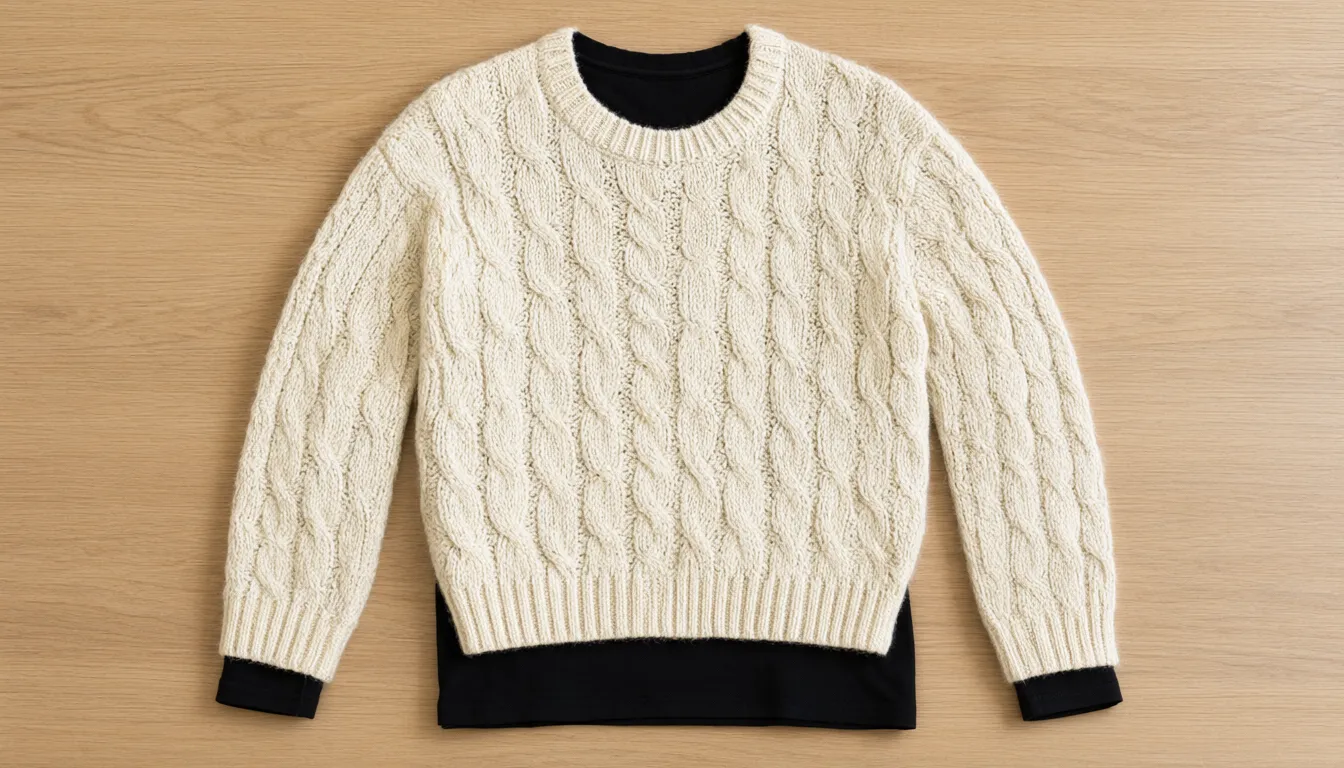
| Chunky or coarse wool knit | Fitted long-sleeve tee | Wide-strap tank | Thin-strap camisole on its own | Keeps the knit off the skin on the arms and back; adds warmth where the knit gapes |
| Fine-gauge knit or cardigan | Wide-strap tank or fitted short-sleeve tee | Camisole if the neckline is low | Ribbed or bulky layers | Smooth line; the tank covers the bra strap when the cardigan opens |
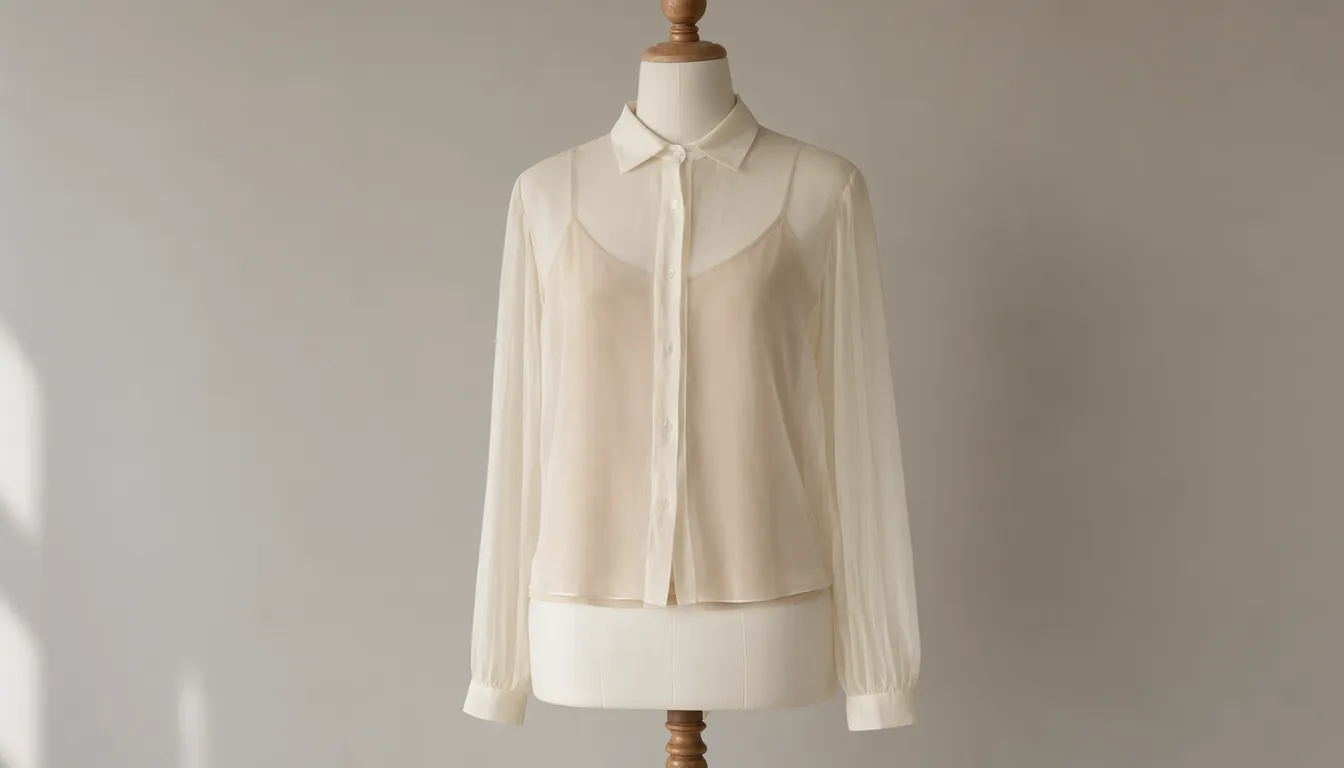
| Sheer or semi-sheer blouse | Skin-tone camisole | Skin-tone tank if the blouse is cut high under the arm | White, or any layer with a visible seam or edge | Lines the blouse without adding a second visible top |
| Buttoned cotton shirt | Wide-strap tank or fitted short-sleeve tee | Camisole under a heavy shirt | Long-sleeve tee under fitted shirt sleeves | Absorbs sweat, hides the bra, no extra bulk in the sleeves |
| Wrap dress or V-neck knit | Camisole with a lower neckline than the V | Tank with a low scoop | Round-neck tee | The base must sit below the neckline or show on purpose |
| Blazer or tailored jacket | Whatever the top underneath needs | Fitted tee worn as the top | Long sleeves under a close jacket sleeve | The jacket is the layer that comes off; dress the top half for that moment |
| Winter coat (outdoors only) | Fitted long-sleeve tee under a knit | Tank plus a warm knit | Relying on the base for warmth | The coat does the outdoor work; the base layer cannot replace it |
Under a chunky or coarse wool knit
A coarse knit is where a base layer earns its keep twice. It keeps scratchy fibres off your skin, and it adds warmth on the arms and back, where a loose jumper lets air move. Wool itch is a response to the stiffer, thicker fibres in a yarn, those above roughly 30 micrometres, not an allergy to wool (Zallmann et al., 2017), so a smooth layer between you and the yarn solves it for most people. A fitted long-sleeve tee is the best choice here: our fitted long-sleeve cotton tee with a scoop neck is 90% cotton, 10% elastane and, as we write this, can be bought in M and L in black and dark blue and in 3XL in electric blue. Its scoop sits low enough to disappear under a crew-neck jumper.
Under a fine-gauge knit or a cardigan
Fine knits show every ridge underneath, so the base must be smooth, flat-edged and close-fitting, with nothing bunching at the waist. A wide-strap tank is the most useful piece, because it does two jobs at once: it smooths the line under a fine jumper, and when the cardigan is worn open its straps cover a bra strap completely. That is the job the Women’s cotton tank top with wide straps, eight shades was designed for: a scoop neck, a full run from XS to 2XL, and at the time of writing black, white and champagne available from S to 2XL, beige in S and L to 2XL, ashes of roses from S to XL.
Under a sheer or white blouse
A sheer blouse needs a lining, and a camisole is a lining you can take on and off. The rule is to make it disappear rather than add it: a camisole close to your skin tone, with thin straps and nothing printed or seamed on it, turns a see-through blouse into a lined one. We explain the colour logic in its own section below.
Under a buttoned shirt
A shirt is a woven fabric that does not stretch, so anything bulky underneath shows as ridges at the side seams and buttons that pull. The two jobs a base does under a shirt are handling sweat, because woven cotton or viscose shirts show damp patches, and hiding the bra. A wide-strap tank does both. A short-sleeve fitted tee does too, and adds a little warmth at the top of the arm: our fitted round-neck cotton tee is cut close enough to sit flat under a shirt, and is the broadest of our tees, made from 2XS to 3XL, although at the time of writing each colour is available in only some sizes, so check yours. A long-sleeve tee under a close shirt sleeve, on the other hand, twists and bunches at the elbow; it is the one combination we would avoid.
Under a wrap dress or a V-neck
Here the neckline rules everything. A wrap dress or V-neck jumper exposes a triangle of skin, and the base layer either sits completely below the point of the V or deliberately shows above it as a neat edge. The in-between, where a scoop peeks out at one side when you lean, is what looks accidental. A camisole has the lowest neckline of the four pieces, so it is usually the answer; check it in a mirror, leaning forward.
Under a blazer
A blazer is warm, about 0.36 clo for a thin single-breasted jacket by the ASHRAE tables, but it is also the layer most likely to come off indoors. Dress for that moment: the top you wear under a blazer should look finished on its own, so a fitted tee worn as the top is often the best “base”. If you wear a camisole under a blouse under a blazer, that is three layers on the trunk and none on the arms beyond the blouse sleeve, which is fine at a desk and cool on the walk home.
Fabric for cold weather: cotton, microfibre, mesh or wool blend
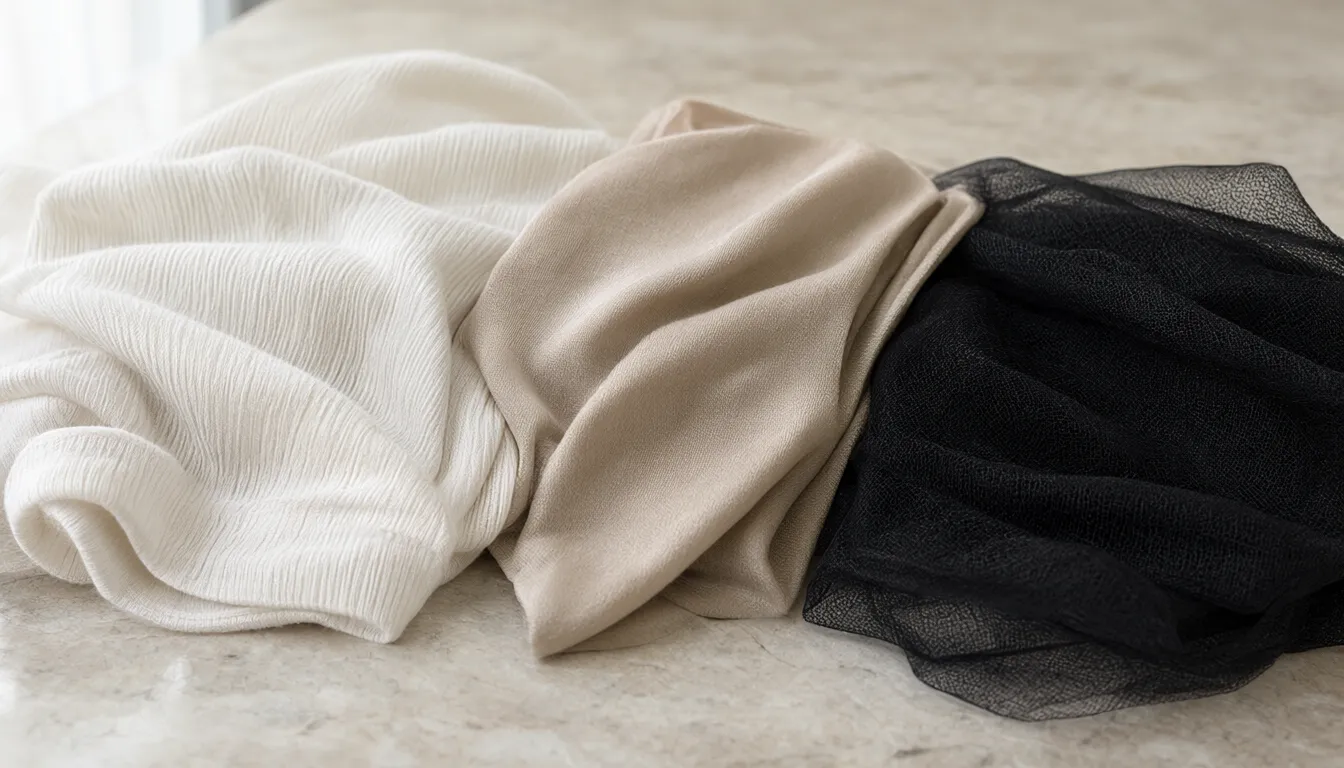
Cotton is the best everyday choice for a winter base layer, because it is soft, holds moisture without feeling clammy at desk-level activity and rarely builds static under wool. Microfibre is the smoothest under fine knits but more prone to static in dry, heated air. Mesh is decoration, not warmth. A wool blend is the warmest-feeling of our fabrics, but read its label: ours is mostly viscose.
Our working scorecard below rates each fabric family for the jobs a winter base layer does. The scores are our judgement from making, wearing and handling these fabrics, not laboratory measurements; where research supports a score, we cite it underneath.
| Fabric (ours) | Feels warm | Handles sweat at a desk | Static under wool | Smooth under fine knits | Shows under sheer | Our overall winter use |
|---|---|---|---|---|---|---|
| Cotton 90/10 | 3 | 4 | Low | 3 | Low if skin-tone | Everyday default |
| Microfibre 80/20 | 2 | 3 | Higher | 5 | Low if skin-tone | Short, smart days under fine knits |
| Mesh 80/20 | 1 | 3 | Higher | 2 | High (it is the point) | Decoration only |
| Wool blend 22/70/8 | 4 | 4 | Low to medium | 3 | Medium | Coldest weeks, outdoor commutes |
Cotton 90/10: the everyday default
Cotton absorbs more water vapour than synthetics before it feels wet. European textile law sets a conventional moisture allowance of 8.5% for cotton against 5.75% for polyamide filament and 1.5% for elastane (EU Regulation 1007/2011, Annex IX), which is part of why a cotton layer stays comfortable against the skin on an ordinary office day. The trade-off is the other end of the day: once cotton is genuinely wet, after a fast walk or a crowded train, it stays wet longer, so on very active winter days it is the wrong fabric. For desk days, errands and evenings, it is the right one. All our cotton camisoles, tanks and tees use the same combed cotton with 10% elastane.
Microfibre 80/20: the smoothest line, with a static catch
Microfibre is a dense knit of very fine polyamide filaments. It lies flatter than cotton, has no surface texture to print through a fine-gauge knit and slides under a sleeve rather than gripping it. Its weakness in winter is static. Heating cold outdoor air makes it much drier: air at 0 °C and 80% relative humidity, warmed to 20 °C indoors without added moisture, ends up at about 21% relative humidity, and at 5 °C and 85% outdoors it ends up at about 32% (our calculation from the saturation-vapour-pressure equation in FAO Irrigation and Drainage Paper 56). Dry air lets charge build up. A Japanese occupational-safety study that compared cotton and polyester bedding found the polyester could charge the person handling it to more than 10 kV, enough for a shock, even at 50% humidity (Endo et al., 2019). Synthetic layers rubbing against wool in a 20% office are the classic crackle-and-cling combination. If you love microfibre under knits, keep the room humidity up, avoid tumble-drying, and keep it for the days with fine knits rather than chunky wool.
Mesh: decoration, not warmth
Mesh is a net, so it traps very little still air. Under a winter outfit it is a visible detail, a sheer sleeve under a short-sleeve knit or a texture at the neckline, not an insulating layer. Our mesh camisoles and tees are made for that look, and in winter they belong over a warmer layer or under an outfit that is already warm enough.
Wool blend 22/70/8: the warmest of ours, honestly labelled
Our wool-blend camisoles and tanks are 22% wool, 70% viscose and 8% elastane, so they are mostly viscose, a regenerated cellulose fibre with a moisture allowance of 13% in the same EU annex. In our experience they feel warmer than cotton on a cold commute, and they are the base we suggest for the coldest weeks. We do not state a fibre diameter for the wool, so we cannot promise they will not itch if you are very sensitive. The two we can offer at the moment are small runs: the Women’s wool tank top with wide straps, black, in S and M as we write this, and a wool-blend camisole with thin straps in L and 2XL. Wash both by hand and dry them flat; viscose is weaker when wet.
Pilling: what rubs, pills
Pills are small balls of broken fibre that form where two surfaces rub, which in winter means the underarm, the sides of the body and the inside of a knit where it meets the layer beneath. A study of knitted fabrics made with identical machines and stitch settings found polyester resisted pilling and abrasion better than cotton or viscose (Hoque et al., 2022). Our microfibre is polyamide, which that study did not test, so read it as a direction rather than a ranking. For a base layer this cuts both ways: a cotton tank may pill a little faster under a coarse jumper than a smooth synthetic one, and a smoother base may also mean less rubbing on the inside of the jumper. Pilling is cosmetic, a shaver removes it, and it is not a sign that the fabric has failed. We are preparing a separate guide to lingerie and underwear fabrics that goes into each fibre in more detail.
Fit rules: length, tightness, neckline and armhole
A base layer that fits does four things: it stays tucked when you bend and sit, it lies flat without squeezing, its neckline stays below the neckline of the top above it, and its armhole and straps stay out of sight. Each of those can be checked with a tape measure or a mirror before you wear it out.
Length to tuck: why ours are long, and why that matters
A tucked base layer stays in place when its hem goes well below your waistband at the back, because the lower back lengthens when you bend. We checked how our tank and camisole length compares with real bodies. Our tank-top chart lists bust and waist ranges for each size and one garment length: 57 cm at S, rising by 2 cm per size to 65 cm at 2XL. To see where that hem lands, we used ANSUR II, a public survey of 1,986 women in the US Army measured in 2010–2012 (ANSUR II), the best large, open set of female body measurements available, though not a sample of European civilians.
For each woman whose chest fell inside our chart, we took her back length from the base of the neck to waist level, subtracted half the drop from the base of her neck to the tip of her shoulder (roughly where a strap sits) and compared the result with the garment length for her size. The median distance from strap to navel level at the back was 39.1 cm (from 35.4 cm at the 5th percentile to 42.9 cm at the 95th). With our lengths, the hem would sit a median 22 cm below navel level at the back when standing, and at least 15 cm below it for 99.7% of the women in the chart. Even allowing for a low-rise waistband several centimetres lower and for the stretch of your back when you bend, that is enough to stay tucked.
That bending stretch is real and measurable. Clinicians test lower-back mobility with the Schober test, marking a segment of skin over the lower spine and measuring how much it lengthens when you bend forward. In a study of healthy adults the 10 cm segment grew by about 3.6 cm in women in their twenties and 2.4 cm in women in their seventies (Yen et al., 2015). A layer that only just reaches your waistband standing will pull out the first time you pick something up.
Three practical consequences. First, our camisoles and tanks are long enough to tuck for nearly everyone the chart covers; the more common problem is too much fabric in a fitted waistband, so smooth it flat to the sides rather than stuffing it down the front. Second, the front uses several centimetres more length than the back, more so with a fuller bust, so check the front hem when you sit. Third, our chart stops at a 102 cm bust; 18.8% of the ANSUR women measured above that and 4.3% below 82 cm, so if you are outside the chart, measure the garment length and compare it with your own strap-to-waistband distance.
Our fitted tees are a gap here: their product pages show only a letter-conversion chart, not a garment length. If length matters to you, ask us and we will measure the tee flat before you order.
How tight should a base layer be?
Close, not compressive. A base layer should touch the skin across the back and sides without leaving marks, with no loose fabric to bunch under a knit. The research on insulation points the same way as comfort: a close fit leaves the air space to the layer above, and nothing is gained by squeezing. Our camisoles, tanks and tees are 8% to 20% elastane, so they follow the body within a size. If your bust and waist fall in different sizes on our chart, go by the bust: a tank that is tight across the bust shortens and rides up, while one that is a little easy at the waist simply skims it. If you are between two sizes overall, take the larger one, as we advise for bodysuits and briefs; a base layer that pulls is colder and less comfortable, not smoother.
The hem can also roll or creep upwards when it ends on the slope between waist and hips: the body is a cone there, and the elastic edge travels up towards the narrowest point. Either tuck it in or choose a length that ends on the hip, below the slope.
A neckline that stays hidden
The base layer’s neckline should sit at least two to three centimetres below the neckline of the top above it at every point, or deliberately above it as a neat visible edge. That margin is our working rule, not a measured standard: it allows for the way a neckline moves when you lean, reach or sit. Check it in a mirror standing, then leaning forward with your hands on a table. A camisole has the deepest scoop of our base layers, a tank the next deepest, a round-neck tee the highest, which is why the matrix above pairs them as it does.
Armholes and straps under shirts and sleeveless tops
Your armpit sits about 10 cm below the tip of your shoulder: in ANSUR II the median drop was 9.6 cm, from 7.8 to 11.5 cm (5th to 95th percentile). A tank’s armhole sits close to the armpit, which is what keeps the side of a bra band covered under a sleeveless outer layer. A camisole’s armhole is lower and open, which is fine under sleeves and visible under a sleeveless dress. A racerback tank draws the straps in towards the spine and keeps them off the shoulder, which helps under wide or boat necklines that would show a normal strap; in cotton, this racerback version is the one to try, and as we write this it can be bought in 2XS, M and L.
Under a shirt, a wide strap that lies flat shows less than a thin strap, because it spreads the edge over a wider area and does not cut a line. If you can see the edge of the tank through a shirt, the fabric of the shirt is the problem rather than the tank: the fix is a skin-tone tank, not a thinner one.
The two-minute mirror test before you wear it out
Most layering problems show up within two minutes in front of a mirror, so we suggest doing this once with each new base layer and outer layer pairing, not every morning:
- Stand and look straight on, in the light you will be in, ideally daylight. Check the neckline margin and that no strap, edge or colour shows through a sheer or pale top.
- Lean forward with your hands on a table. This is when a scoop peeks out of a V and a loose base gapes.
- Reach both arms up and forward, as if for a high shelf. The hem should stay tucked and the armhole edge should not appear at the side of a sleeveless top.
- Sit down on a firm chair for a minute, then stand. Check the back of the waistband with your hand: the base should still be well below it, and there should be no bunched fabric pressing into your back.
- Take the outer layer off. Would you be happy to spend the afternoon in what is left? If not, change the base, not the knit.
- For sheer tops, take a photo with the flash on. A phone flash shows through fabric much more than daylight does, so if the base disappears in the flash photo it will disappear everywhere.
Colour under light and white tops
The colour that disappears under a white or pale top is the colour of your skin, not white. A white camisole under a white shirt shows as a brighter patch with sharp edges, because the shirt lets light through and the white layer reflects it back where your skin would absorb some. A layer close to your skin tone shows as nothing more than your skin.
Japanese garment researchers measured this directly, placing 141 colour chips under white fabrics and asking observers which they could see. The chips closest in colour to skin were the least visible, and the further a colour sat from the skin tone, the more it showed (Yoshino et al., 2000). Match the lightness first, then the undertone: a layer slightly too pink or too yellow shows less than one that is much lighter or darker than your skin.
Our cotton camisole and tank come in beige, champagne and cappuccino among their eight shades. The cotton camisole with fine straps in eight shades is the one we would put under a sheer blouse: 90% cotton, 10% elastane, made from XS to 2XL, and at the time of writing champagne, black and white are available from S to 2XL, beige in S and L to 2XL, cappuccino in M only. Two honest notes. The deepest skin tone in our layering range is cappuccino, and the stock in that shade is thin; if your skin is deeper than that, black often shows less under a white shirt than a beige that is much lighter than you. And under black or very dark sheer tops, black is the working colour, for the same reason.
The colour rule matters less under opaque knits, where nothing shows through. There, choose the colour for the moment the knit comes off: a black tank under a black cardigan reads as a single outfit, a beige one as underwear.
How many to own for a winter rotation
The number of base layers you need is set by how often you wear them and how often you wash, not by a fixed list. Because a base layer sits against the skin and takes sweat at the underarms, we treat it like underwear and wash it after each wear, or after two short wears at most. Our working formula is: wears per week divided by washes per week, plus one for drying, plus one spare.
| Wear and wash rhythm | Base layers you need | A mix that works |
|---|---|---|
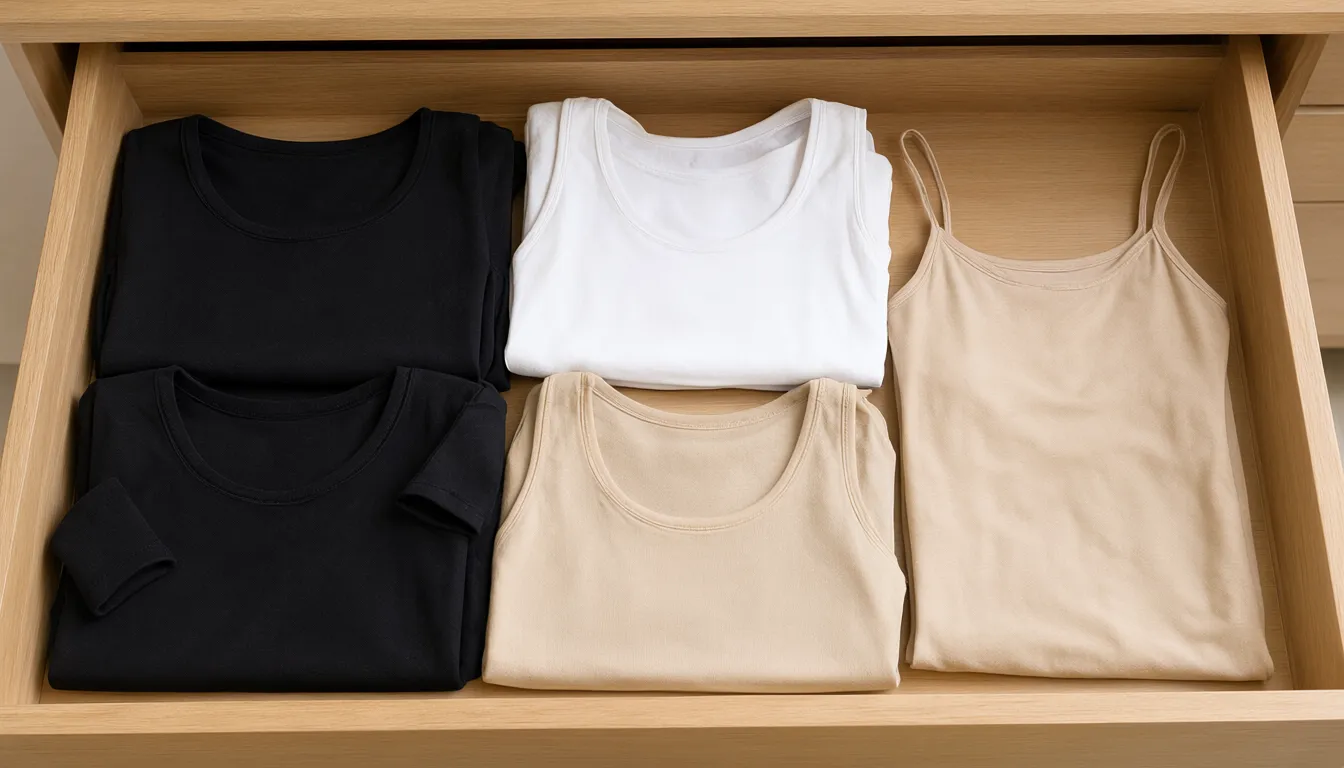
| 5 days a week, washing twice a week | 3 + 1 + 1 = 5 | 2 long-sleeve tees, 2 wide-strap tanks, 1 camisole |
| 5 days a week, washing once a week | 5 + 1 + 1 = 7 | 2 long-sleeve tees, 3 tanks, 2 camisoles |
| 3 days a week (part-time or hybrid), washing twice | 2 + 1 + 1 = 4 | 1 long-sleeve tee, 2 tanks, 1 camisole |
| 7 days a week, washing every two to three days | 3 + 1 + 1 = 5 | 2 long-sleeve tees, 2 tanks, 1 camisole |
The mix depends on your wardrobe, not ours. If most of your winter tops are coarse knits, shift the count towards long-sleeve tees. If you wear sheer blouses and wrap dresses, add a second camisole. If you wear shirts to work every day, tanks do most of the work. At our current prices, which reflect a 50% promotion as we write this, the first rotation in the table costs about €94: €16.99 for the cotton camisole, €17.99 for each cotton tank and €19.99–20.99 for each fitted tee. We have no reliable wear-count for base layers, so do not replace them by the calendar: when a hem or neckline stops lying flat, replace that piece, not the whole set.
Camisoles and tanks also make one of the lowest-risk presents in lingerie, because size is forgiving: our guide to buying lingerie as a gift explains how to find her size without asking, and why a camisole is a safer first gift than a bra.
Bodysuit or base layer?
A bodysuit is the one base layer that cannot untuck, because it fastens between the legs, and that is its single big advantage on cold days. The price is the extra step at every bathroom visit and a wash after every wear. If you tuck fitted tops into trousers or skirts most days and the small of your back is always the part that gets cold, a long-sleeve bodysuit is worth trying alongside the pieces on this page. Our 20 bodysuit outfit ideas include the layering looks we use in autumn and winter, and our guide to choosing a bodysuit by fabric, neckline and cut covers which one to start with. We are preparing a separate guide to winter layering with bodysuits, so we will not repeat the bodysuit arguments here. For untucked outfits, long jumpers and days when you want nothing between your legs but your underwear, the camisole, tank and tee remain the simpler base.
What goes under the base layer
The bra comes first and the base layer second, because the base layer is chosen to cover the bra, not the other way round. Under a camisole with thin straps, a bra with straps set at a similar point on the shoulder keeps the two together; under a wide-strap tank, any bra strap is covered. A smooth moulded bra in your skin tone shows least under a fine knit. If you are not sure of your size, our guide to measuring your bra size at home is the place to start. A plain camisole or tank gives no support, and a camisole with a built-in cup gives only light support, so it suits smaller busts and quiet days rather than replacing a bra for everyone.
Who should choose which layer, and who should skip it
Choose by what you wear on top most often and by how you feel the cold, not by the name of the garment. This table is the short version of everything above.
| If you… | Choose | Skip |
|---|---|---|
| Wear coarse wool knits most days | Fitted long-sleeve tee | A camisole on its own under the knit |
| Feel the cold mostly in your arms at a desk | Fitted long-sleeve tee under the knit | Thicker sleeveless layers, which add nothing on the arms |
| Wear shirts to work | Wide-strap tank or short-sleeve fitted tee | Long-sleeve tee under fitted shirt sleeves |
| Wear sheer, white or pale blouses | Skin-tone camisole | White camisole |
| Wear wrap dresses and V-necks | Camisole with a lower neckline than the V | Round-neck tee |
| Commute on foot or by bike in the cold | Wool-blend tank or long-sleeve tee under a knit and coat | Cotton on very active days, because once soaked it stays wet |
| Get static and cling under wool | Cotton | Microfibre or mesh on the driest days |
| Have a long torso | Check strap-to-hem length against your own body | Assuming the letter size gives you the length |
| Are pregnant | Plain stretch tank or tee in a size that is not tight | Anything that pulls across the abdomen; we do not make maternity layers |
Five layering mistakes we see every winter
- Choosing the base for the street, not the room. The heaviest piece you own goes on the outside, where it can come off. A thick base layer is a commitment for the whole day.
- A white camisole under a white shirt. It makes the layer more visible, not less. Skin tone first, then black for dark or sheer black tops.
- A base that stops at the waistband. If it only just tucks in standing, it will escape the first time you bend. Look for a hem well below the waistband at the back.
- Long sleeves under fitted sleeves. Two sets of sleeves in a close blazer or shirt twist at the elbow and pull the cuffs up. Save the long-sleeve tee for knits and loose sleeves.
- Synthetics under wool in a dry office. Static and cling are not a fault of your knit; they are what dry heated air does to that combination. Cotton next to the skin is the simplest fix.
Honest limits: what these layers will not do
Camisoles, tank tops and fitted tees are everyday layers, not technical thermals. They add a small amount of insulation, they keep rough or see-through fabrics off your skin and they close gaps, but they are not made for hours outdoors below freezing, for sport where you sweat and stop, or for outdoor work. For those, choose a purpose-made thermal base layer from a specialist; we do not make thermal underwear, and none of our layers is brushed.
We also make no claim about warmth beyond what the physics and our product data support. The insulation values in this guide come from the ASHRAE tables or are our estimates, clearly labelled. Our wool blend is mostly viscose, and we do not state a fibre diameter. Our size runs are uneven: as we write this, only the cotton camisole and cotton tank are available across six sizes, most of our fitted tees can be bought only in 2XS or in scattered sizes, and only one of our sleeveless layers is offered in 3XL. The tank-top chart stops at a 102 cm bust and our fitted tees have no garment length on their pages. If you fall outside those, ask us to measure a piece flat for you, or look elsewhere for an extended size range.
Care in one paragraph
Wash base layers inside out at 30–40 °C with a mild detergent, in a mesh bag if they share the drum with jeans or anything with zips, and dry them flat or folded over a rail, away from radiators. Skip fabric softener: it reduces cotton’s absorbency, which is the property you chose it for. Never tumble-dry the elastane blends, and wash wool-blend pieces by hand without wringing, because the viscose in them is weaker when wet. Fold them rather than hanging them, so the straps do not stretch.
All the pieces on this page, and the bralettes and built-in-cup camisoles that sit alongside them, are in every camisole and undershirt we make. For the sleeveless layers alone, our tank tops, by strap width and fabric are filtered separately, and the fitted tees with short and long sleeves have their own section. Start with the outer layer you wear most this winter, choose the base it needs, and build from there.