

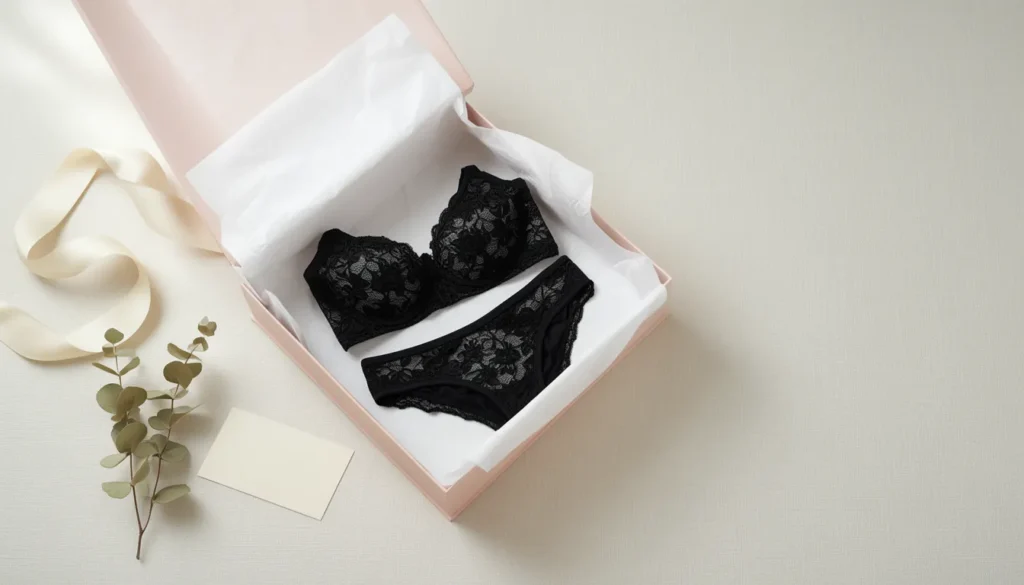
Lingerie is a gift that has to pass three tests at once — size, cut and taste — and the first one fails far more often than the other two. Most of the gift exchanges that come back to our returns centre in Stara Zagora in January are not about a colour she didn’t like. They are about a band two sizes off, a cup that gaped at the top, a pair of briefs that rolled down at the waist. Taste can be forgiven. A wrong size can’t be worn, and it tends to say something the giver never meant to say.
The short answer: to buy lingerie as a gift, copy the size from a bra and a pair of briefs she wears often, check which country’s sizing system the label uses, choose stretch and soft-cup styles over moulded ones, stay within the coverage and colours she already picks for herself, and keep every tag and the packaging intact so she can swap the size if she needs to. The rest of this guide is the detail behind each of those steps, written by the team that grades our sizes and handles the exchanges when a gift misses.
We say “her” throughout because that is who most of these gifts are for, but nothing in the method depends on it. It works for anyone who wears a bra and briefs, and for any giver — a partner, a sister, a mother buying for a grown daughter, a friend who knows exactly what the other person wears.
Why lingerie is one of the hardest gifts to get right
Lingerie is hard to give because fit is close to binary: a jumper one size too big is still a jumper, but a bra one band size too big gives no support and a pair of briefs one size too small digs in within an hour. Unlike most clothing, the pieces sit directly against the body, carry load (the bra band holds most of the bust’s weight), and are sized on two or three dimensions instead of one. That leaves very little room for a guess.
The little consumer data that exists points in one direction. A 2012 UK poll reported by Marie Claire found that one in four women threw away a lingerie gift from a partner after wearing it once, citing the wrong size, impracticality or simply the wrong style. Another British survey, commissioned by a laundry brand, put the share of Christmas knickers that never leave the drawer at 48%, with 31% the wrong size, 12% “too racy” and 10% a colour the recipient would never wear. Neither survey published a sample size, so treat the exact numbers loosely — but they agree on the order of the problems: size first, taste second, everything else a distant third.
There is also a reason the wrong size stings more than the wrong colour. A bra two sizes too small reads as a hint about her body; one two sizes too big reads as a judgment of a different kind. Neither was intended, and both are avoidable. The other common miss is the gift that is really for the giver — the piece chosen for how it looks in a photograph rather than how it feels at four in the afternoon. We will come back to both.
The upside is real, though. Done well, lingerie is one of the few gifts that improves something a person uses every single day. Many people replace bras and briefs as a chore, buying the same plain styles again because those are the ones that work. A gift that takes what already works and makes it a little finer — the same cut in lace instead of plain jersey, the same size in a colour she has never treated herself to — is the kind of gift that gets worn until it falls apart. That is the target this guide aims at.
The gift risk map: size risk versus taste risk
Every lingerie gift carries two separate risks: size risk (will it fit?) and taste risk (will she want to wear it?). Separating the two is the most useful thing a gift buyer can do, because they have different fixes. Size risk is solved with information — labels, measurements, an ally who knows. Taste risk is solved by staying close to what she already chooses. Most failed gifts are high on both at once: a push-up lace set in a colour she never wears, in a size someone guessed.
Here is how the main pieces compare, based on how we grade and cut them and on what tends to come back for exchange.
| Piece | Size risk | Why | Taste risk | Why |
|---|---|---|---|---|
| Lace or mesh briefs, Brazilians | Low | One letter size; stretch fabric gives several centimetres of tolerance | Low–medium | Only coverage (thong vs brief) has to match |
| Camisole with built-in cup | Low–medium | Stretch body; the cup is soft and forgiving | Low | Wearable under or as a top layer |
| Bralette (wire-free, letter-sized) | Low–medium | Letter size only; little real support above a C cup | Low | Comfort-first; easy to like |
| Fashion bodysuit in stretch knit | Medium | Letter size plus torso length | Low–medium | Works as a top; neckline matters |
| Soft-cup (unpadded) lace bra | Medium–high | Band and cup must both be right, but the cup fabric adapts | Medium | Sheer cups are not for everyone under clothes |
| Moulded, padded or push-up bra | High | Band, cup and cup shape; foam does not adapt | Medium | Shape preference is personal |
| Matching bra-and-brief set | High | Two sizes locked together in one pack | Medium–high | Two style choices at once |
| Lace or satin bodysuit with cups | High | Cup, torso length and narrow size runs | High | An occasion piece, not a daily one |
| Very sheer, cut-out or novelty pieces | Low | Often one-size or stretch | Very high | The classic “gift for the giver” |
Read the table as a map rather than a ranking. The top rows are where you can buy with a single letter size and a good guess at her style; the bottom rows are where you need real information before you spend money. The last row is the odd one out — almost no size risk, almost all taste risk — and it is the category behind most of the “it stayed in the drawer” stories.
The reason the top rows are so forgiving is mechanical. Our stretch fabrics extend roughly 9 cm (3.5 inches) beyond their relaxed measurement, and the product dimensions we publish allow a ±2 cm tolerance, so a pair of briefs in the right letter size will accommodate a fairly wide range of bodies. A bra band has far less latitude. One band size is a 5 cm step in underbust, one cup letter is a 2 cm step on our European chart (about an inch in UK sizing), and the band is built to be firm because it carries the support. That is why “roughly her size” works for briefs and fails for bras.
The practical rule that falls out of this: start in the low-risk rows and spend the extra effort on the detail, not on structure. A beautiful pair of lace briefs in her exact size is a better gift than an expensive moulded set in a guessed one.
How to find her size without asking: the drawer method
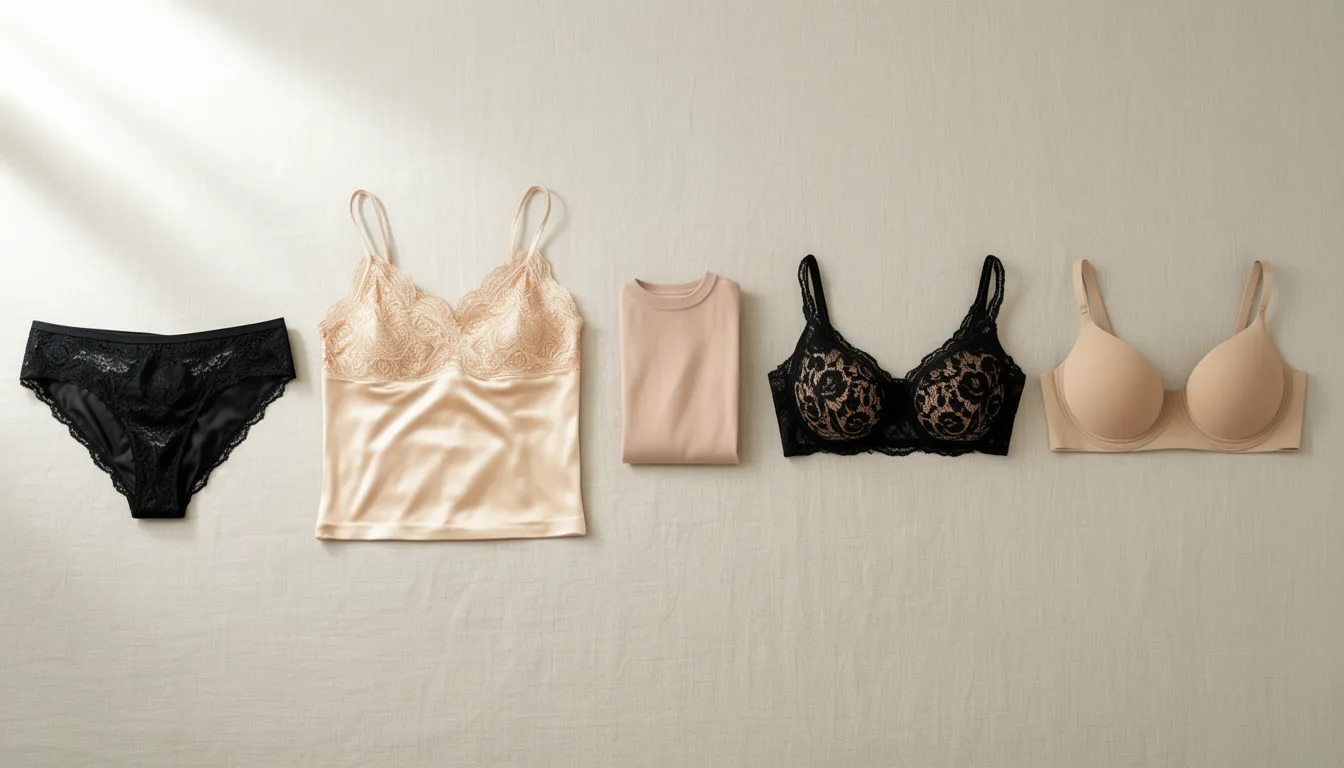
The most reliable way to find someone’s lingerie size without asking is to read it from garments she already wears — not to estimate it from her figure, and not to convert it from her dress size. A label in a well-used bra tells you what fits her body and what she is used to feeling, which for a gift matters just as much. The method takes about five minutes and works best in four steps.
Step 1: Pick the right garment to copy
Not every bra in a drawer is a reliable source. The one to copy is the one she reaches for most — usually the one you see on the drying rack every week — and ideally one bought in the last six to twelve months, which is also roughly how long a bra in regular rotation keeps its shape. Ignore these:
- The special-occasion bra at the bottom of the drawer. It was often bought for one outfit, sometimes in a different size, and rarely worn enough to prove it fits.
- Sports bras. Many are sized S/M/L on compression, which tells you little about her band and cup.
- Anything from before a big change — pregnancy, breastfeeding, significant weight change. Breast volume and ribcage can both move, and older bras will carry the old size.
- A single bra on its own. If you can, read two everyday bras. If they agree, you have a size. If they disagree, you have learned something too — see the section on asking, below.
The same applies to briefs: the pair in heaviest rotation, not the novelty pair from a hen party.
Step 2: Find the label and work out which system it uses
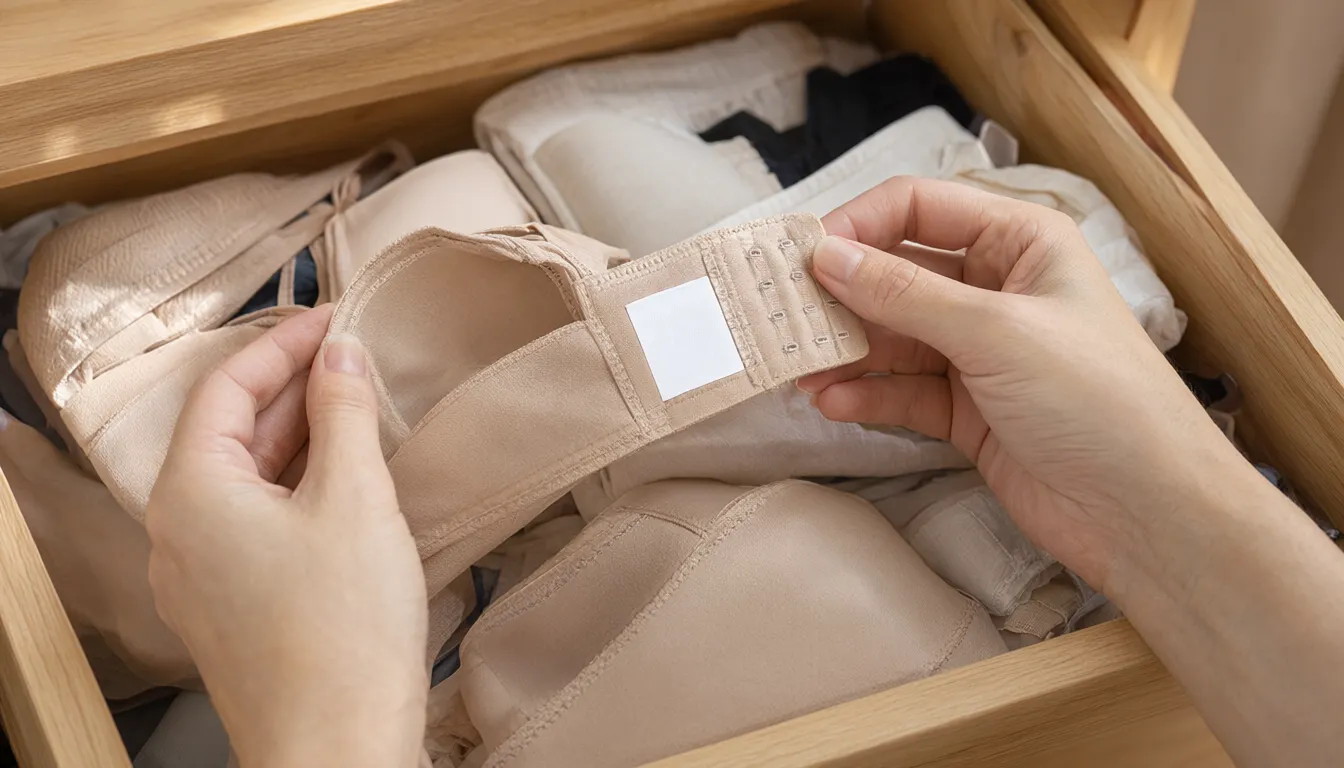
On a bra the size is usually on a sewn-in label inside the band, close to the hook-and-eye closure or on the side wing; on some brands it is printed directly onto the fabric, and on older bras it may be faded — look on the hook tape itself, where it is sometimes stamped. On briefs, check the inside of the back waistband or the side seam. Write down everything you see, because a label often carries two or three systems at once and you need to know which number is which.
This is where most gift buyers go wrong without realising it. The same ribcage is written differently in different countries: an EU 75 band is a UK and US 34, a French, Belgian or Spanish 90, and an Italian 3. Copy “90C” off a French-made bra and order “90C” from a European size chart, and you have bought a bra three band sizes too big. The table below shows the bands side by side, as they appear on our own size chart, with the letter size we print alongside.
| EU band | UK / US band | France / Belgium / Spain | Italy | Our letter size | Underbust (cm) |
|---|---|---|---|---|---|
| 70 | 32 | 85 | 2 | S | 68–72 |
| 75 | 34 | 90 | 3 | M | 73–77 |
| 80 | 36 | 95 | 4 | L | 78–82 |
| 85 | 38 | 100 | 5 | XL | 83–87 |
| 90 | 40 | 105 | 6 | 2XL | 88–92 |
| 95 | 42 | 110 | 7 | 3XL | 93–97 |
Cup letters are simpler up to D, where A, B, C and D mean the same thing in EU, UK and US sizing. Above D the systems split: a UK DD is an EU E, a US DDD is an EU F, and the gap widens from there. If her label reads DD or higher, copy the brand’s country along with the size, and use the full conversion tables in our bra size guide before ordering. Every one of our bra labels carries three sizes at once — for example 34C | 75C | M — so that a UK, US or EU size copied from her drawer can be matched directly, without converting anything.
Step 3: Look at which hook she uses — and then leave the size alone
Most bras have two or three hook positions, and a new bra is designed to fit on the loosest one, so that the wearer can move inward as the band elastic relaxes over months of washing. If her favourite bra is fastened on the tightest hook, the band has simply aged. That is useful information, but not a reason to change the size: a new bra in the same band will feel noticeably firmer than her worn-in one, and that firmness is correct. The temptation to “fix” her size from a hook position — going down a band, say — is exactly the kind of guess that comes back as an exchange.
The only exception is if every bra she owns is on the tightest hook and riding up her back. That pattern suggests her band is too big across the board — but that is a conversation for her and a fitter, not something to correct with a gift.
Step 4: For briefs, measure the garment, not the person
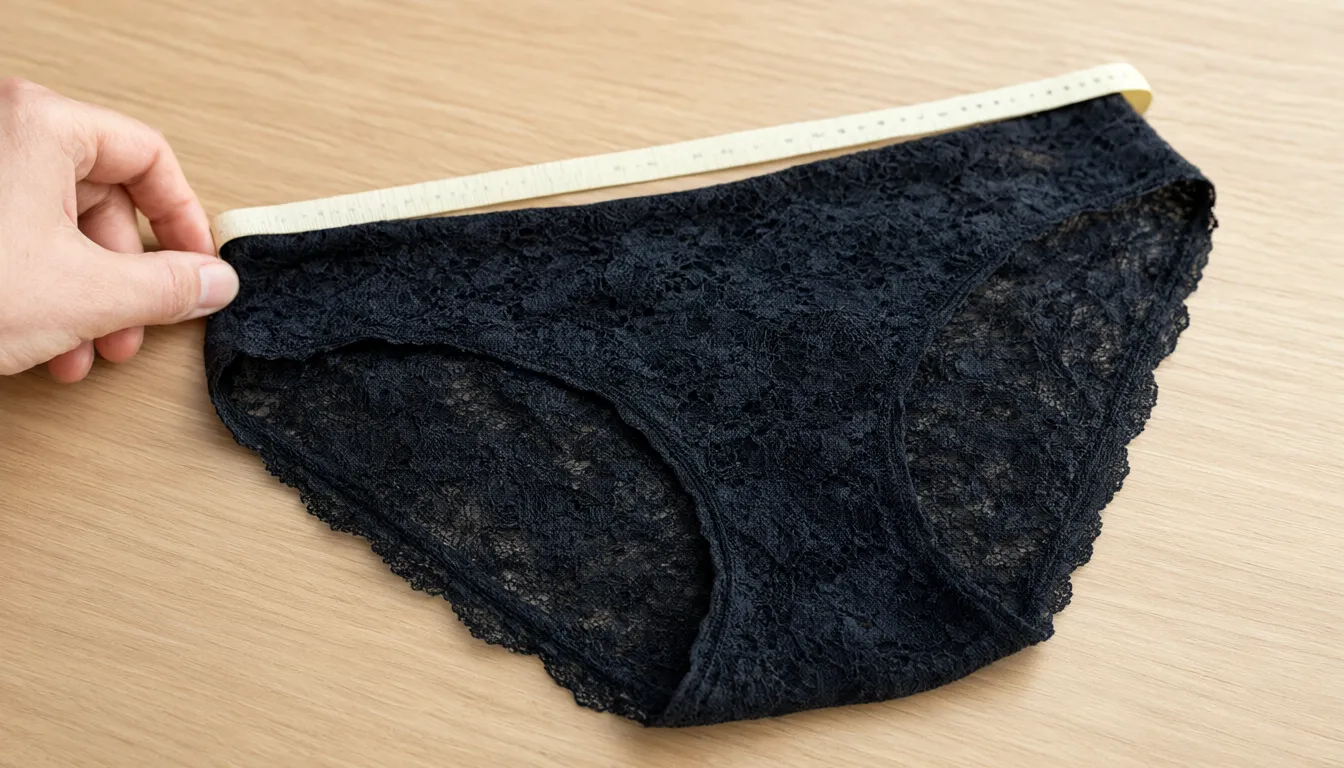
If the label on her briefs is missing or unreadable, you can still size them accurately with a tape measure — on the garment. Lay her favourite pair flat on a table without stretching it, measure straight across the top edge of the waistband from one side to the other, and double the figure. That gives you the relaxed waist circumference of a pair you know fits her. Then compare it with the product dimensions the shop publishes for the style you are considering.
We print those dimensions in the product images for exactly this reason. Our lace-and-mesh Brazilian briefs, for example, measure 54, 56, 60 and 62 cm around the relaxed waist in S, M, L and XL, stretch about 9 cm further when worn, and are measured flat with a ±2 cm tolerance. If her pair measures 57 cm laid flat and doubled, M is the size. Two cautions make the method work: compare like with like (a high-waisted pair and a low-rise Brazilian sit at different heights, so their waistbands measure differently), and if you land exactly between two sizes in briefs, go up. A slightly roomy brief is wearable; a tight one digs in and rolls.
What doesn’t work
- Guessing a bra size by eye. A cup letter is a difference between two measurements, not a volume. The same breast volume can be a 32D on a narrow ribcage or a 36B on a wider one — sister sizes that look identical and fit completely differently. Even experienced fitters measure rather than guess.
- Converting from her dress size. There is no fixed relationship between dress size and bra size. Two women in the same dress can be four band-and-cup combinations apart.
- Measuring her while she sleeps, or “hugging to estimate”. Both appear in other gift guides. Neither gives you an underbust measurement taken level, snug and on an exhale, which is what a band size needs.
- Buying a size smaller as a compliment. When surveys ask why gift knickers go unworn, “too small” is the usual way the size turns out to be wrong. It never lands as intended.
When asking is the better move — and how to ask
Asking is the better move when the gift is a bra in a moulded, padded or push-up style, when her body has changed recently, or when the two garments you checked disagree. In those cases a surprise in the wrong size is not really a surprise — it is an errand you have handed her. Three ways to ask that keep most of the magic intact:
- Ask an ally to read, not guess. A sister, a close friend or a flatmate may already know her size — but ask them to check a label rather than tell you from memory, and if they can, to send you a photo of it. A photo shows every size system printed on the label, which a remembered “she’s a 34B” doesn’t — and people tend to remember their friends’ sizes from years ago.
- Ask for the size, keep the piece secret. “I want to get you something nice to wear — what size are you in your favourite bra, and what brand?” is a perfectly good question. The surprise is in what you choose, the colour and the detail. Very few people mind being asked their size; far more mind receiving the wrong one.
- Make the exchange part of the gift. A short note in the box — “tags are still on; if anything isn’t right it can be swapped” — takes the pressure off both of you. It works best when you have already checked how the exchange works (see the timing section below).
One more option is underrated: shop together. Choosing a piece side by side, with her picking the size and you picking the colour or the detail, keeps the gesture and removes nearly all of the size risk. It also tells you exactly what she likes for next time.
Choosing the style: copy her coverage, upgrade the detail
The safest lingerie gift is a slightly more special version of what she already wears: the same coverage and cup type, in a finer fabric or a colour she likes but rarely buys for herself. This is the single most effective way to cut taste risk, and it costs nothing but a careful look at her drawer.
Coverage is not negotiable
Coverage — how much of the bottom the back of a brief covers — is a comfort preference people hold for years, and a gift is the wrong place to challenge it. A thong leaves the back almost completely open, usually with a strip just one to two centimetres wide; a Brazilian sits between a thong and a classic bikini brief, covering roughly half; a full brief covers the bottom entirely. If her drawer is full briefs, a thong is a taste gamble no matter how beautiful it is. If she wears thongs every day, a full brief may feel like a step backwards. Count what is there and stay in the same column. When in doubt between two neighbouring cuts, a Brazilian is the most widely accepted middle ground.
Match the cup type she already lives in
The same logic applies on top. If her drawer is smooth moulded T-shirt bras, she has chosen not to show the shape of the nipple under clothes, and an unlined sheer lace bra may feel too exposed for daily wear — even if it fits perfectly. If she lives in wire-free bralettes, don’t assume she wants structure. If she wears padded or push-up styles, she likes lift and shape that a soft cup will not give. Match the category first, then upgrade within it.
Colour: read the drawer, then go one step further
Most everyday drawers are built on three neutrals — black, white and a skin-tone nude — because those disappear under clothes. A neutral in a finer fabric is the lowest-risk colour choice there is. If you want something more personal, look at the colours she wears in her clothes rather than her underwear, and pick a softened version: champagne instead of white, a dusty rose or “ashes of roses” instead of pink, a deep bordeaux instead of bright red. Bright red for Christmas or Valentine’s Day is a tradition that works only if she already wears red; otherwise it is the colour most likely to end up unworn.
Upgrade one notch, not three
The pattern that works is a single step up: plain cotton briefs become cotton with a lace front; a plain microfibre bra becomes the same cup type with a lace overlay; a nude T-shirt bra becomes a nude bra in a finer fabric. Three steps at once — new coverage, new cup type and a new colour — is a different person’s drawer.
Two of our pieces fit this one-step logic particularly well. The All-Lace Brazilian Panties in five shades sit squarely in the lowest-risk row of the risk map: a single letter size from S to 2XL, a moderate Brazilian coverage that suits both thong and brief wearers, and colours from black and white to champagne and electric blue at €14.99 a pair. If she wears camisoles or layers under cardigans, a cotton-lace camisole with a built-in cup is a gift that crosses from lingerie into everyday clothing — cotton against the skin, lace at the neckline, a soft cup that removes the need for a separate bra, in band-and-cup sizes from 32C to 40C plus 34D and 36D (EU 70C–90C, 75D and 80D), in black, beige and champagne. Both are easy to like and easy to wear on an ordinary Tuesday, which is the real test of a lingerie gift.
Fabric and comfort: lace, mesh, satin and cotton as gifts
Fabric decides whether a lingerie gift is worn every week or once. It controls how the piece feels after eight hours, how forgiving the fit is, and how much care it demands — and a gift that creates a chore is a gift that stays in the drawer. Here is what each of the four gift fabrics means in practice.
| Fabric | How it feels | Best gift for | Watch out for | Care |
|---|---|---|---|---|
| Stretch lace | Textured, light, slightly cool | Briefs, soft-cup bras, bodysuits | Lace edges can scratch sensitive skin; quality varies hugely | Hand-wash cool, dry flat |
| Mesh | Smooth, airy, sheer | Briefs, layering pieces | Very sheer; snags on jewellery and rough nails | Hand-wash or a mesh bag on delicate |
| Satin | Slippery, cool, with a sheen | Occasion bodysuits and camisoles | Little stretch, so sizing must be accurate; shows water marks | Hand-wash cool, never wring |
| Cotton and cotton blends | Soft, breathable, matte | Everyday sets, camisoles, sensitive skin | Less “special” on its own — pair it with lace detail | Machine-wash cool on delicate |
Lace deserves the most attention because it varies the most. Stretch lace with a scalloped edge lies flat against the skin and moves with the body; stiff, rigid lace with a cut edge can feel scratchy along the leg line within an hour. Running a piece of lace across the inside of your wrist tells you most of what you need to know. In our own designs the lace usually sits on top of a smoother layer — lace over microfibre at the band, lace with a mesh back — so that the decorative fabric isn’t the one doing the work.
If she has sensitive skin, eczema or reacts to some fabrics, err toward cotton and lighter colours. Dermatology references such as DermNet’s overview of textile contact dermatitis note that reactions to clothing are usually caused by finishing resins, dyes and elastic rather than by the fibre itself, and that natural fibres and lighter-coloured fabrics, which carry less dye, are the gentler choice. A cotton-lined gusset in briefs matters here too, and is worth checking for in any product description. And if she has ever mentioned that a particular material makes her itch, that comment is worth more than any gift guide.
Finally, think about the care label from her side. Most lace, mesh and satin pieces last longest when washed by hand in cool water and dried flat, away from heat. For someone who loves lingerie, that is a pleasure; for someone whose underwear goes in the machine with everything else, it is a reason not to wear the piece. If she is in the second group, a cotton piece with lace detail is the better bet.
If the gift is a bra: how to make the riskiest piece work
A bra is the highest-risk lingerie gift because it needs two measurements and a cup shape to be right at the same time. You reduce that risk in three ways: copy her current size exactly instead of improving on it, choose a style whose cups can adapt to her shape, and leave the most shape-specific styles to her.
Copy her size — don’t correct it
Bra fit research consistently finds that most women wear a size a professional would change. In one Australian study, 85% of 104 women assessed against professional fitting criteria were in an ill-fitting bra. You might conclude that a gift is the moment to buy her the “right” size instead. It isn’t. A gift in a size she has never worn arrives as a correction, not a present, and even if it is technically better, it will feel unfamiliar on the first wearing — which is usually enough for it to go back. Copy what she buys. If she wants a fitting, that is a separate gift entirely, and it is hers to book.
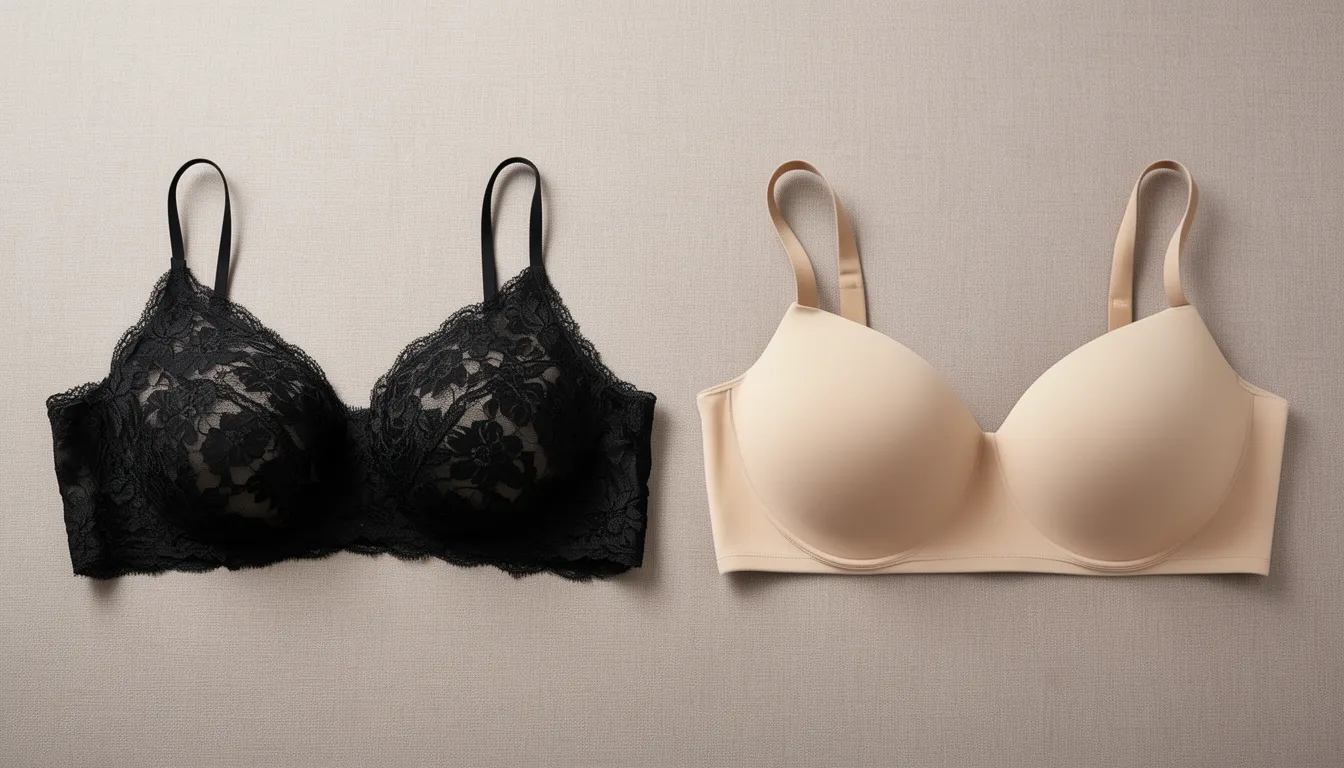
Choose soft cups over moulded ones
There is a physical reason soft cups make better gifts. Breasts change volume across the month: an MRI study in the British Journal of Radiology measured breast volume in 15 women at three points in the menstrual cycle and found an average swing of 76 ml per breast — about 13.6% of volume — with the fullest point just before menstruation. A moulded foam cup has a fixed shape; it either matches the breast on a given day or it gapes or overflows. A soft, unpadded cup in stretch lace follows the breast instead, which makes it far more tolerant of the small mismatches a gift-buyer can’t control: a slightly different cup shape from her usual brand, a projection a little fuller or shallower than expected, a day in the month when she is a little larger.
That is why, when a customer asks us what bra to give, we usually point them to a soft-cup lace style in the size printed on her favourite bra. For fuller busts, a lace soft-cup bra cut for fuller cups covers bands from 32 to 40 and cups from C to E (EU 70C to 90E) in black, white and beige, with lace cups over a smoother microfibre band. For larger band sizes, the Lace Soft-Cup Bra in Extended Sizes runs up to 42D (EU 95D, our 3XL). Both are €29.99, and both are the kind of bra that is easier to get right from a label than a moulded or padded style.
If her exact size isn’t available
Bra sizing has a well-known workaround called sister sizing — going down a band and up a cup (34C to 32D) keeps the cup volume while changing the ribcage fit. It is a useful tool when someone is trying bras on. For a gift, we don’t recommend it. A sister size changes two variables at once on a body you can’t check, and the band — the part that carries the support — is exactly the variable you most need to be right. If her size is out of stock in the style you wanted, choose a different style that has her exact size.
Leave push-up and plunge styles to her
Push-up, plunge and heavily padded bras are shape tools: they are designed for a particular breast shape and a particular effect, and two women in the same size can find the same push-up comfortable or impossible. Unless she already wears that exact style — same brand, same model — these are the bras least suited to being chosen by someone else.
Matching sets, bodysuits and occasion pieces
Matching sets and bodysuits look like the classic lingerie gift, but both carry a sizing complication that separate pieces don’t. Knowing what it is lets you decide whether to buy one or to assemble the same effect another way.
The two-size problem with sets
A bra-and-brief set is usually sold as one item in one size, which ties the brief size to the bra size: a 32C bra with S briefs, a 34C with M, and so on. That pairing assumes a top-and-bottom proportion many women don’t have. A 32D bust with M hips, or a 36B with S hips, is completely ordinary — and either one makes a fixed set wrong somewhere. Before buying a set, check that her bra size and her brief size both line up with the pairing on offer. A set like this black lace bra and thong set, for example, comes as 32C with S briefs or 34C with M (EU 70C and 75C); it is a lovely gift for someone whose sizes match that pairing and the wrong one for someone whose don’t.
The workaround is to build the set yourself from separates in the same colour family: a bra in her band and cup, briefs in her letter size, chosen in matching black, champagne or nude. Separates also let you match coverage exactly — the set might come with a thong when she wears Brazilians. It is the same mix-and-match logic we use for swimwear, and it removes the one sizing problem a set adds.
Bodysuits: the letter size is only half of it
A fashion bodysuit is sized in letters like a top, but it also has to span the distance from shoulder to crotch, and that torso length varies more between women than height suggests. If she is noticeably tall or long in the body, a bodysuit that fits her bust and hips can still pull at the shoulders and the gusset. That is why we treat torso length as a sizing factor in its own right in our guide to choosing a bodysuit. For a gift, two rules cover most cases: if she sits between sizes, go up; and if she is very long in the torso, choose something else.
A lace bodysuit is still one of the most rewarding gifts in this whole category, for one reason: it doesn’t have to stay in the bedroom. Worn with high-waisted trousers or a skirt, it becomes an evening top — there are a few ways to do that in our bodysuit styling guide — which answers the most common complaint about lingerie gifts, that they are something only one person enjoys.
Lace and satin occasion pieces: check the size before you fall for the piece
The lace bodysuits in our range and our satin pieces are cut in small runs, and most styles are only available in two or three sizes at any one time. That is the honest downside of occasion pieces made in limited batches: the one you fall in love with may not exist in her size. The sensible order is the reverse of how most people shop. Start from her size, filter to what is available in it, and choose the piece from that list. Bodysuits with built-in moulded cups need a band-and-cup size like a bra, which moves them to the bottom of the risk map; styles without cups are sized in letters and are the safer choice.
Timing, tags and exchanges: the 30-day clock
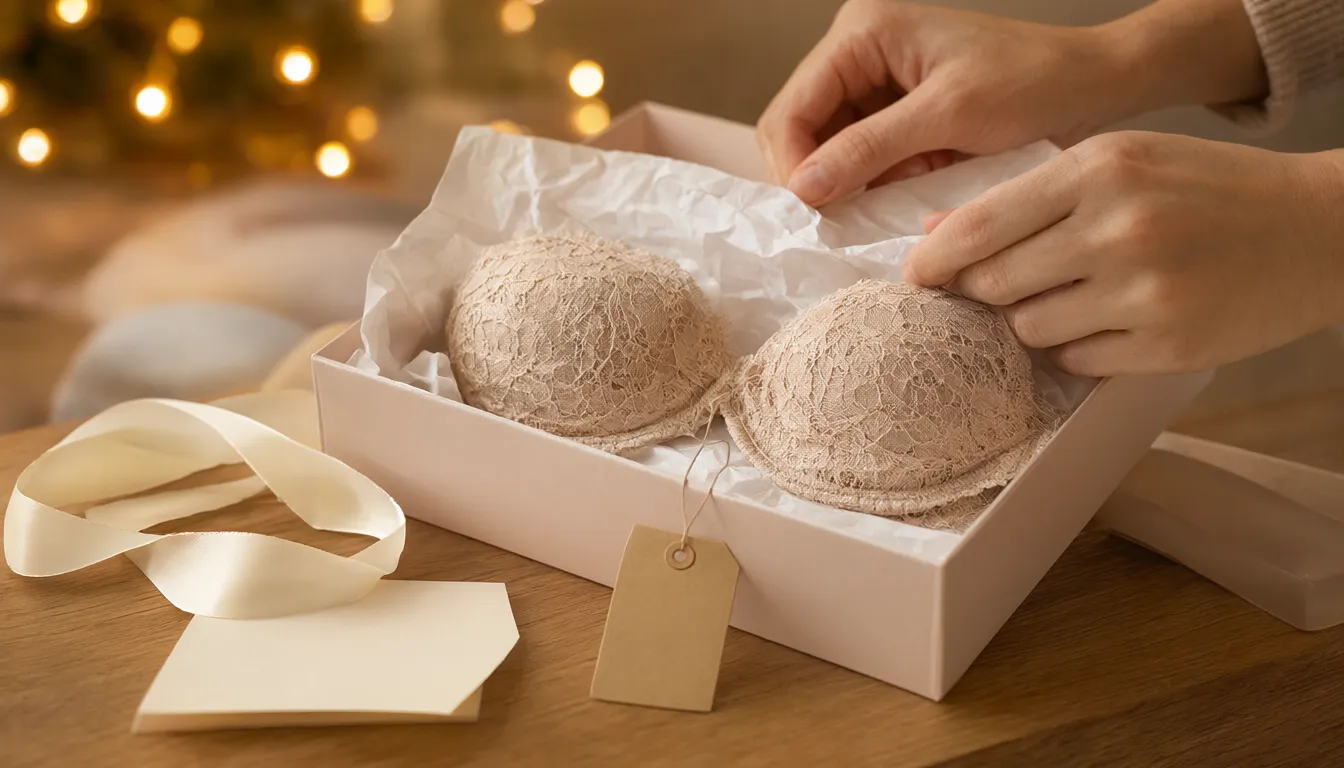
Our exchange window for lingerie is 30 days from delivery — not from the day she unwraps it — so the date you order decides how much time she will have to swap a size. Under our return and exchange policy, return or exchange requests can be made within 30 days of delivery for items that are unworn and still have their tags attached. You can choose an exchange, store credit or a refund; exchanges and store credit are processed within one business day of the return reaching us, refunds within seven business days, and return postage is paid by the customer.
The trap is the organised buyer. Orders are processed within one business day, and standard delivery within Europe takes three to eight business days after that (one to three with express). Order in the first week of November and the parcel arrives in mid-November — which means the exchange window closes in mid-December, before the gift is opened. Here is how the timing works out in practice for a European address on standard shipping:
| If you order… | It usually arrives… | The 30-day exchange window closes… | Verdict |
|---|---|---|---|
| In the first week of November | Mid-November | Mid-December — before Christmas | Give it early, or be very sure of the size |
| In the last week of November | First half of December | Early January | Good: time to exchange after Christmas |
| Between 1 and 10 December | About 7–23 December | Early to late January | The sweet spot for Christmas |
| After about 10 December | Standard may arrive after 24 December | — | Choose express (1–3 business days) |
| In the last week of January | Late January to early February | Late February to early March | The sweet spot for Valentine’s Day |
Carriers slow down in the weeks before Christmas, so treat the delivery column as typical rather than guaranteed, and add a margin if the date matters.
Why the tags and the hygiene liner matter
Across the EU, online purchases carry a legal 14-day right of withdrawal under the Consumer Rights Directive (2011/83/EU), and handling clothing to check its fit doesn’t remove that right — the Court of Justice of the EU explicitly compared other goods with garments that may be tried on and still returned in its 2019 ruling in case C-681/17. The same directive, however, lets shops exclude sealed goods that are unsealed after delivery and can’t be returned for hygiene reasons, which is why so many retailers refuse briefs with the protective liner removed. Policies on intimate apparel vary from shop to shop, so the practical rules are the same everywhere: leave the tags on, leave any hygiene liner in place, try briefs on over her own underwear, and keep the packaging and the order confirmation until she is sure.
Since an exchange is requested by the person who placed the order, keep the order number somewhere you can find it in January. A discreet way to hand over that safety net is a card in the box that says the size can be swapped, with no mention of the price.
Who should — and shouldn’t — buy lingerie as a gift
Lingerie is a good gift when the giver knows the recipient’s drawer well enough to stay within her style, and a risky one when that knowledge isn’t there. We would rather you bought something else than bought the wrong thing from us, so here is our honest split.
It is a good idea if:
- you are in a long-term relationship and have seen what she wears day to day;
- you have two everyday garments with labels that agree on her size;
- you are a close family member or friend buying a comfortable, everyday-pretty piece rather than something intimate in tone — a camisole, lace-trimmed briefs, a cotton bralette;
- you are choosing for how it will feel to her, not for how it will look to you.
Think twice, or choose a different gift, if:
- The relationship is new. You don’t yet know her taste, and lingerie carries a message about intimacy that may not match where the two of you are.
- She is pregnant, recently postpartum or breastfeeding. Bust size can change month to month in this period, and maternity and nursing bras are a specialist category we don’t make. A voucher from a maternity specialist, or something non-fitted, is kinder.
- She has had breast surgery, including a mastectomy or reconstruction. Fit can depend on post-surgical needs that only a specialist fitter should assess.
- The recipient is a colleague or an acquaintance. In almost every workplace and social setting, this is simply not an appropriate gift.
- The honest answer to “who is this really for?” is “me”. That is the gift most likely to go unworn, and the one most likely to be resented a little.
In any of these cases, shopping together, a gift of her choosing, or a non-fitted piece will do more for her than the most carefully guessed bra.
Before you check out: a seven-point checklist
- Size from two garments, not one — her most-worn bra and briefs, bought in the last year.
- System checked — you know whether “75”, “34”, “90” or “3” is EU, UK/US, French or Italian.
- Exact size, no improvements — no going down a size as a compliment, no correcting her band, no sister sizes.
- Same coverage and cup type as the pieces she already wears.
- A colour from her drawer or her wardrobe, or a softened version of one.
- Soft rather than moulded if it is a bra; separates rather than a set if her top and bottom sizes don’t follow the set’s pairing.
- Timing and exchange planned — ordered inside the window, tags left on, order number saved, a note in the box.
If all seven are ticked, you are buying from the top rows of the risk map with real information, and the gift has every chance of becoming the piece she reaches for first. When you are ready to choose, start with her size and browse our women’s lingerie and underwear range by that size first — it is the quickest way to see only what will actually fit her, and because every bra label carries EU, UK/US and letter sizes together, a size copied from her drawer in any of those systems is the size you will find on ours.
Lingerie gift questions, answered
How can I find out her bra size without asking?
Read it from a bra she wears often — ideally two everyday bras bought in the last year. The size is on a label inside the band near the hooks or on the side wing. Note every number on it, because one label can show several systems: EU 75 = UK/US 34 = French 90 = Italian 3. If two bras agree, copy that size exactly. If they disagree or the label is unreadable, ask a close friend to check a label for you, or ask her directly.
What is the safest lingerie gift if I don't know her size?
Stretch briefs or Brazilians in lace or mesh, a camisole with a soft built-in cup, or a wire-free bralette. These are sized in letters and the fabric stretches several centimetres, so a near-miss still fits. Moulded and push-up bras, matching sets and lace bodysuits with cups are the riskiest, because band, cup and shape all have to be right at once.
Should I size up or down if I'm not sure?
For briefs and bodysuits, size up: a slightly roomy fit is wearable, a tight one digs in and rolls. Never size down as a compliment — "too small" is the usual way gift knickers turn out wrong. For bras, don't guess between sizes or switch to a sister size; copy the exact size from her label, and choose a different style if that size isn't available.
Is a matching bra and panty set a good gift?
Only if her sizes match the set's pairing. Sets usually tie the brief size to the bra size — a 32C with S briefs, a 34C with M — and many women are a different size on top and bottom. If hers don't line up, build the set from separates in the same colour: a bra in her exact band and cup, and briefs in her own letter size and usual coverage.
What colour lingerie should I buy as a gift?
A colour she already wears. Black, white and skin-tone nude are the safest, because she can wear them under clothes. For something more personal, take a colour from her clothes and choose a softer version — champagne instead of white, dusty rose instead of pink, bordeaux instead of bright red. Bright red works as a gift only if she already wears red.
Can lingerie bought as a gift be exchanged?
At Tiara Galiano, yes: return or exchange requests can be made within 30 days of delivery for unworn items with tags attached, and an exchange ships within one business day of the return reaching us. The clock starts at delivery, not at unwrapping, so time the order and keep the order number. Elsewhere, check the policy first — many shops won't take back briefs with the hygiene liner removed.
Is lingerie a good gift for a new partner, a friend or a family member?
For a new partner it is usually too early: you don't know her taste yet, and lingerie sends a message about intimacy. Between close friends or family, everyday-pretty pieces such as a camisole, lace-trimmed briefs or a cotton bralette work well. For colleagues and acquaintances, lingerie is not an appropriate gift.