

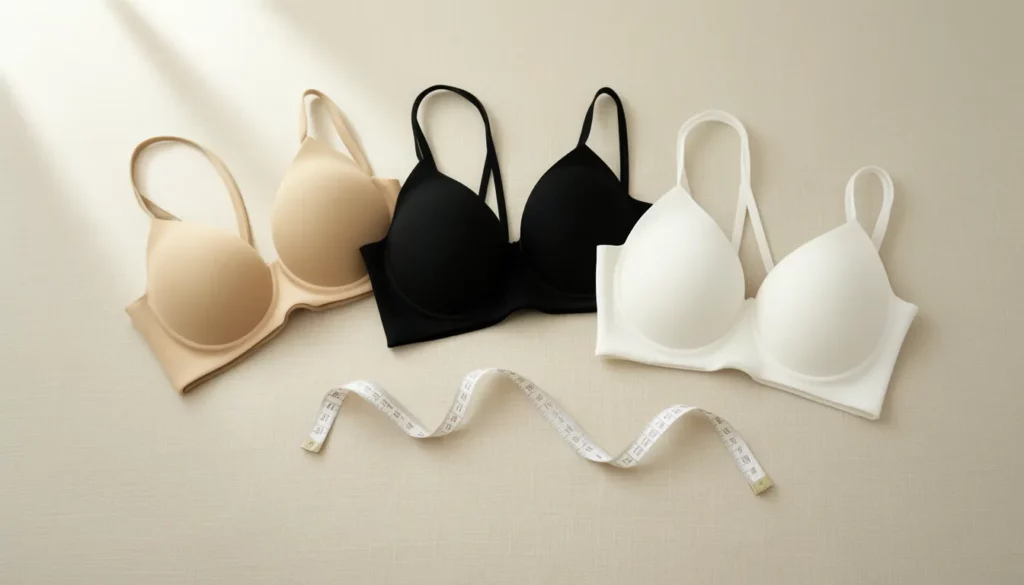
Somewhere between 70% and 100% of women are wearing the wrong bra size. That range is not sloppy writing — it is what the clinical literature actually reports, and the spread tells you something useful before you pick up a tape measure. When researchers in Manchester measured 102 women referred for breast reduction, every single one was in the wrong size. When an Australian team assessed 104 women against professional fitting criteria, 85% were. The number moves with the sample, but the direction never does.
We grade and sell bras, so we see the consequence of this from the other end: returns where the band was the problem and the customer blamed the cup, and size charts that send the same body to three different labels depending on which country the brand comes from. This guide gives you the measuring method, the arithmetic behind cup letters, and — the part most guides skip — a proper explanation of why a UK 34E, a US 34DDD and an EU 75F are the same bra. It takes about five minutes and a soft tape measure.
The short version: two measurements and one subtraction
Your bra size is built from two numbers. The band size is your underbust circumference — measured directly beneath the bust, where the band sits. The cup size is not a measurement at all but a difference: your bust circumference minus your underbust, where each inch of difference is one cup letter. That is the whole method. Everything else in this guide is about measuring those two numbers accurately and translating the result into whichever sizing system the label in front of you happens to use.
- Measure your underbust, snug and level → that is your band.
- Measure your bust at the fullest point, gently and level.
- Subtract the first from the second. Roughly 2.5 cm (one inch) of difference = one cup letter.
- Put the two together, then check the result on your body — the tape gives you a starting size, not a verdict.
Before you pick up the tape: five things that change the number
Measurement conditions change bra size calculations by more than most people expect, and the effect is documented. A 2006 study in the British Journal of Sports Medicine measured 16 large-breasted women in two different respiratory states and found that taking the chest circumference during inspiration increased the calculated band size and decreased the calculated cup size — one breath, two errors, in opposite directions. Get the conditions right and the arithmetic takes care of itself.
- Wear an unpadded bra, or nothing. A padded or push-up bra adds two to four centimetres to the bust reading, which is one to two cup letters of error before you start.
- Breathe out and stay relaxed. Do not hold a big breath and do not squeeze the ribs empty. Normal, relaxed exhalation is the state to standardise on.
- Keep the tape parallel to the floor. It rides up at the back far more easily than you would think. A mirror is more useful here than a second person.
- Stand naturally, arms down. Arms raised lifts the ribcage and the bust. Take the reading with your arms at your sides, then lower the tape.
- Pick one unit and stay in it. Centimetres are easier for European labels, inches for UK and US ones. Converting mid-process is where most arithmetic errors creep in.
Step 1 — Band: measure your underbust
The band size is your underbust circumference, taken directly below the breasts against the ribcage. Wrap the tape firmly — snug enough that it stays put if you let go, but not tight enough to dent the skin — keep it level all the way round, breathe out, and read the number. In centimetres, round to the nearest 5: that number is your European band (68–72 cm → 70, 73–77 cm → 75, and so on). In inches, round to the nearest even number: 32.5 inches becomes 34, 32 stays 32.
Two notes from our side of the counter. First, the band does the supporting — not the straps — so it is the measurement worth taking twice. A band that measures correctly and fits snugly on the loosest hook gives you two more hooks of life as the elastic relaxes over the months. Second, if you have read older advice telling you to add four or five inches to your underbust, ignore it. That rule dates from an era of non-stretch bra fabrics and, applied to a modern elasticated band, it reliably produces a band that is too big and a cup that is too small — precisely the error pattern the fitting studies keep finding.
Step 2 — Bust: measure the fullest point
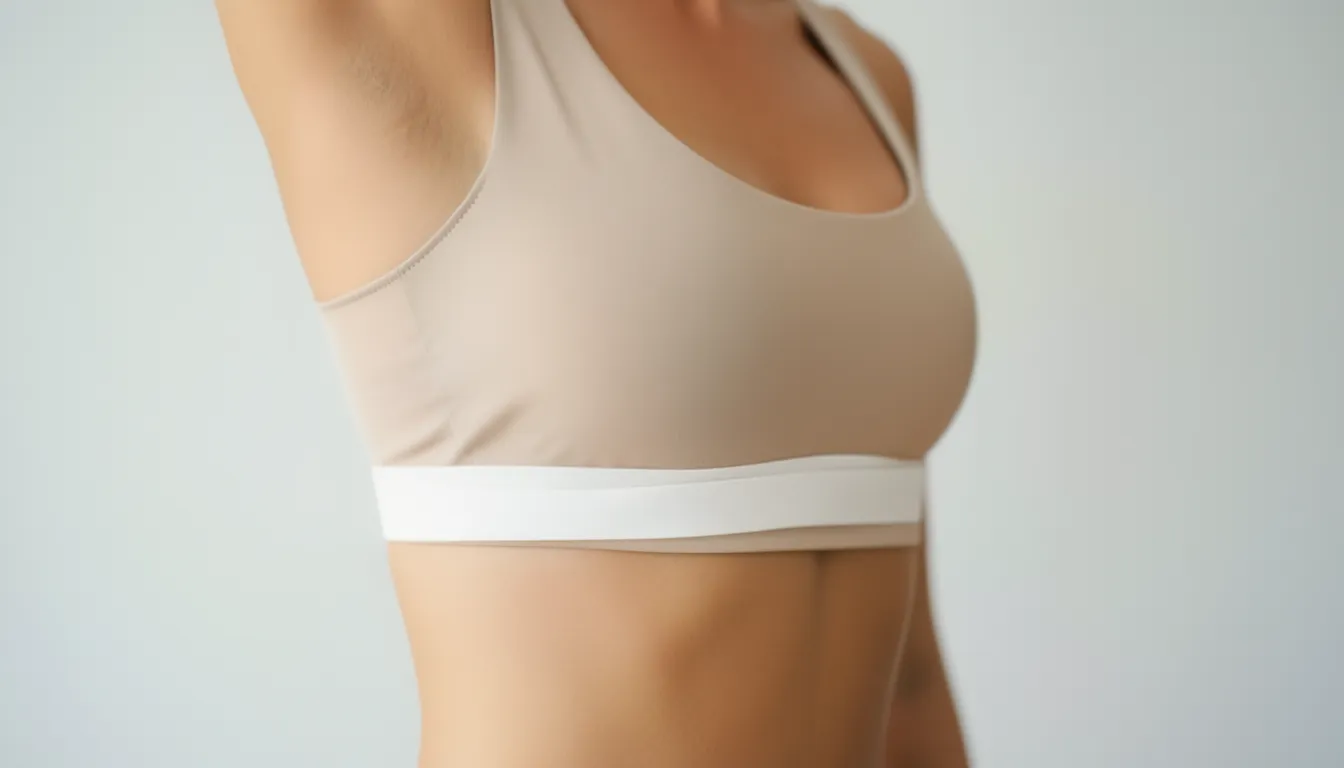
The bust measurement is taken around the fullest part of the breasts, usually at nipple level, with the tape resting gently rather than pulled tight. This is the opposite instruction from the band, and the difference matters: pulling the tape firm here compresses breast tissue and gives you a smaller cup than you actually need, which is the single most common reason a calculated size comes out one or two cups too small. Let the tape sit. Keep it level at the back — it wants to slide down here as much as it wanted to ride up before.
If your breasts are soft, full at the bottom or sit low on the chest, take a second reading while leaning forward at about 90 degrees so the tissue hangs into the tape, then use the larger of the two numbers as your working measurement. Standard tape methods are known to under-read on softer or fuller busts, and the same research team behind the respiratory-state findings has argued for measuring the breast itself rather than the whole chest for exactly this reason. If your two readings differ by more than about 3 cm, treat the standing measurement as the floor and the leaning one as the ceiling, and expect to try both sizes.
Step 3 — The subtraction: turning a difference into a cup letter
Subtract your underbust from your bust. Each inch (about 2.5 cm) of difference equals one cup letter, counting up from A at one inch. A 34-inch bust over a 32-inch underbust is a two-inch difference, which is a B cup on a 32 band: a 32B. In centimetres the same logic holds — a 90 cm bust over a 75 cm underbust is a 15 cm difference, which is roughly six steps of 2.5 cm, landing on an EU 75F.
| Difference (inches) | Difference (approx. cm) | US cup | UK cup | EU cup |
|---|---|---|---|---|
| 1 | 2.5 | A | A | A |
| 2 | 5 | B | B | B |
| 3 | 7.5 | C | C | C |
| 4 | 10 | D | D | D |
| 5 | 12.5 | DD | DD | E |
| 6 | 15 | DDD / F | E | F |
| 7 | 18 | G | F | G |
| 8 | 20 | H | FF | H |
| 9 | 23 | I | G | I |
One conceptual point is worth more than the whole table, because it explains most sizing confusion: a cup letter is a ratio, not a volume. A D cup means “four inches more than the band”, so a 32D and a 40D hold visibly different amounts of breast tissue — the 40D is substantially larger. This is why “I’m a D cup” tells a fitter almost nothing on its own, why sister sizing works at all, and why moving band size without moving cup letter changes the fit dramatically.
Two worked examples
Example one, in centimetres. Underbust reads 74 cm, bust reads 89 cm. The band rounds to the nearest 5, giving an EU 75 — which is a UK/US 34. The difference is 15 cm, which is six steps of 2.5 cm, so the cup is the sixth letter counting from A: an EU F. Written out across systems, that is EU 75F = UK 34E = US 34DDD. If this person searched for “34F” out of habit because she once wore a French label, she would land in the wrong cup in two of the three systems.
Example two, in inches, with a wrinkle. Underbust reads 31 inches, so the band rounds up to 32. Bust reads 35 inches standing, but 36.5 inches leaning forward — a soft, full-bottomed shape that the standing measurement under-reads. Standing gives a three-inch difference (32C); leaning gives four and a half (between 32D and 32DD). The sensible move is to order the 32D first, keep the C as a fallback, and let the mirror decide. Note what did not change: the band. When two calculations disagree, they almost always disagree about the cup.
The conversion problem: why one bra carries three different labels
International bra sizing diverges in two independent places — the band number and the cup letter — and they diverge for different reasons. Band numbers differ by unit: European bands are your underbust in centimetres rounded to the nearest 5, while UK and US bands are historically inch-based, which is why an EU 75 and a UK/US 34 describe the same ribcage. Cup letters differ by convention: above a D cup, UK sizing inserts doubled letters (DD, FF) and US sizing inserts DD and DDD, while European sizing simply carries on through the alphabet with single letters. The volumes are identical; only the naming diverges.
| Underbust (cm) | EU band | UK / US band | France / Spain | Italy | Australia |
|---|---|---|---|---|---|
| 63–67 | 65 | 30 | 80 | 1 | 10 |
| 68–72 | 70 | 32 | 85 | 2 | 12 |
| 73–77 | 75 | 34 | 90 | 3 | 14 |
| 78–82 | 80 | 36 | 95 | 4 | 16 |
| 83–87 | 85 | 38 | 100 | 5 | 18 |
| 88–92 | 90 | 40 | 105 | 6 | 20 |
| 93–97 | 95 | 42 | 110 | 7 | 22 |
Read the two tables together and the puzzle resolves. A UK 34E, a US 34DDD and an EU 75F are one and the same bra: same ribcage, same six inches of difference, three naming conventions. The French system is the one that catches people out most often, because its band numbers run 15 higher than the European ones while the cup letters stay European — so a French 90C is an EU 75C, not an EU 90C.
This is exactly why our own labels carry three sizes at once. A bra listed as 32C|70C|S is telling you the US size, the EU size and the letter size on one tag, so nobody has to convert anything at checkout — the cotton moulded-cup bra in three neutrals at €19.99 runs 32B|70B|S through 38B|85B|XL on exactly that system. And an honest caveat: charts are a map, not a guarantee. Cup depth, wire width and band tension vary between manufacturers, so treat any conversion as the size to try first rather than the size you are.
Sister sizes: when the band is right but the cup is not
Sister sizes are bra sizes that hold the same cup volume on a different band, and they exist because the cup is defined relative to the band. Going down one band size and up one cup letter keeps the volume the same while tightening the ribcage fit; going up one band and down one cup does the reverse. It is the most useful trick in bra buying and it costs nothing to try.
| If your calculated size is… | Band too loose? Try | Band too tight? Try |
|---|---|---|
| 32C | 70C | 30D | 65D | 34B | 75B |
| 34C | 75C | 32D | 70D | 36B | 80B |
| 36C | 80C | 34D | 75D | 38B | 85B |
| 38D | 85D | 36DD | 80E | 40C | 90C |
| 40D | 90D | 38DD | 85E | 42C | 95C |
Use it when one part of the fit is right and the other is not — not as a way to avoid re-measuring. And note the direction that most often solves a real problem: if the band rides up at the back and the cups feel roomy, the fix is usually a smaller band with a bigger cup letter, not a smaller everything. If you are between two bands with cups that both work, our practical rule is to take the smaller band, because bands loosen with wear and cups do not tighten.
Cup shape, not just cup size: what a tape cannot measure
Two bras in identical sizes can fit completely differently, because a cup has a shape as well as a volume — and a tape measure only ever reports volume. This is the part of bra fitting that never appears in a calculator, and it explains the frustration of buying your “correct” size and still finding the cup wrong in a specific way. Three variables do most of the work.
- Projection. The same volume can be distributed forward into a deep, narrow cup or spread out into a shallow, wide one. If cups gape at the top edge but the underwire sits correctly, the cup is usually too projected for your shape rather than too big — the volume is in the wrong place.
- Root width and wire width. The breast root — where the tissue attaches to the chest wall — varies from narrow to wide in people of the same band size. A wire that is too narrow sits on breast tissue at the side instead of behind it, which is felt as pinching under the arm. A wire that is too wide slides toward the armpit and never settles.
- Where the fullness sits. Fullness at the top of the breast usually needs a lower-cut or stretch-topped cup, or it will spill; fullness at the bottom sits better in a moulded or full-coverage shape. This is also why the leaning measurement helps: it captures a shape the standing tape misses.
The practical upshot is that when a bra in your calculated size fails, the right question is not always “what size next?” but “what shape next?” A gaping top edge, pinching at the side and a floating centre panel are three different problems with three different answers, and only one of them is solved by changing the letter on the label. As manufacturers we grade a moulded cup and a soft cup on different blocks for exactly this reason — the number on the tag is the same, the geometry underneath is not.
Check the result on your body — the tape is only a starting point
A calculated size is a hypothesis to test, not an answer, and there is a sobering study behind that statement. When UK researchers asked 24 women to report their own bra fit and then assessed the same bras against professional fitting criteria, every participant failed the objective assessment, and their self-reported impressions matched the objective findings only about half the time. Feeling fine is not evidence of fitting well. Five checks in front of a mirror will tell you more than any calculator:
- The band sits level. It should run straight across your back, not ride up toward the shoulder blades. Raise both arms: it should not climb more than a centimetre or so.
- Two fingers, no more. You should be able to slide two fingers under the band with mild resistance, fastened on the loosest hook.
- The cups contain everything. No spilling over the top or at the underarm, no wrinkling or gaping at the edge. Gaping means too big; spillage means too small.
- The centre panel lies flat. On a moulded or wired bra, the piece between the cups should touch the breastbone. If it floats, the cups are usually too small.
- The straps carry a minority of the load. Loosen them until they are just taking up slack. If the bra falls without strap tension, the band is too big.
When the tape lies: bodies the standard method handles badly
The two-measurement method was designed around an average shape, and it becomes progressively less reliable the further you sit from that average — which is a limitation of the method, not of the body. The fitting literature is consistent on this: the discrepancy between measured and correct size is greatest in women with larger breasts, because soft, full or low-sitting tissue is exactly what a chest circumference measures poorly. Knowing where the method loses accuracy is more useful than pretending it doesn’t.
- Fuller busts (D and above). Take the leaning measurement, expect the tape to under-read, and start with the larger of your two calculated cups. A cotton moulded-cup bra cut for fuller cups — ours runs 32D|70D|S up to 38D|85D|XL — is built with a deeper cup and a wider wire than a standard B-cup shape at the same band, which is why swapping style matters as much as swapping size here.
- Asymmetry. Most people have one breast larger than the other; a visible difference is normal. Fit the larger side and adjust the strap on the smaller one, or choose a moulded cup, which conceals a modest difference better than a soft cup does.
- Pregnancy and the postpartum months. Ribcage and bust both change, sometimes weekly. Re-measure rather than predict, favour flexible bands, and hold off on buying a full set until things settle.
- Weight change, hormonal cycles and age. Breast volume moves with all three. A measurement from two years ago is a historical document, not a size.
- Between two sizes with no clear winner. For everyday wear go up in the cup; for strapless or sports styles go snugger. A wire-free option in letter sizing sidesteps the question entirely — a cotton bralette in fifteen shades at €14.99 is sized S–XL rather than by band and cup, which is genuinely easier when your measurements land on a boundary. The trade-off is real support above a C cup, and we would rather say so.
When a home measurement is enough — and when it isn’t
A home measurement is enough for most people most of the time: it is free, repeatable, and takes five minutes, whereas in-person fittings vary enormously in quality and are not available everywhere. But it has limits, and we would rather name them than pretend a tape measure solves every case.
Measure at home if you…
- are shopping online and need a size to start from — which is the situation this guide is written for
- have a straightforward fit history: your usual size mostly works, and you are checking whether it still does
- are comparing labels across countries and need the conversion more than the measurement
- are buying wire-free or letter-sized pieces, where a centimetre either way matters far less
Get fitted in person — or expect to order two sizes — if you…
- calculate a cup of E or above, where the gap between measured and correct size is widest and cup shape matters most
- have had breast surgery, a mastectomy or reconstruction, where fitting is a clinical question and not a retail one
- have persistent shoulder grooves, neck or upper-back pain that you suspect is bra-related — that is worth a professional pair of eyes, and possibly a clinician’s
- get two calculations more than one cup apart, or have tried three bras in your calculated size and none has worked
- are pregnant or nursing and buying more than one or two pieces at a time
There is no shame in the second list, and it is not a failure of the method. The two-measurement system is a nineteenth-century convenience that has survived because it is easy to communicate between customer, retailer and manufacturer — not because it captures a three-dimensional shape well. Researchers have been calling for a better standardised system since at least 2006. Until one arrives, the honest approach is a good measurement, a size chart read properly, and a willingness to send one back.
How often to re-measure — and why three bras beat one
Re-measure every six to twelve months, and immediately after any meaningful change in weight, pregnancy or medication that affects it. Most bras give six to twelve months of regular wear before the band elastic relaxes past the point where the snuggest hook still does its job — and the tell is specific: you find yourself on the tightest hook within a couple of months of buying, or the band creeps up your back during the day.
The old fitter’s rule — one to wear, one to wash, one to rest — is not a sales line, it is elastane physics. Elastane recovers its length when it is unloaded, so a bra worn two days running never gets the recovery time it was engineered for. Rotating three bras through a week roughly doubles the useful life of each. Wash them cold by hand, or fasten the hooks and use a mesh bag on a gentle cycle, and keep them out of the tumble dryer entirely: heat is what kills elastane, and one hot cycle costs more recovery than a month of wear.
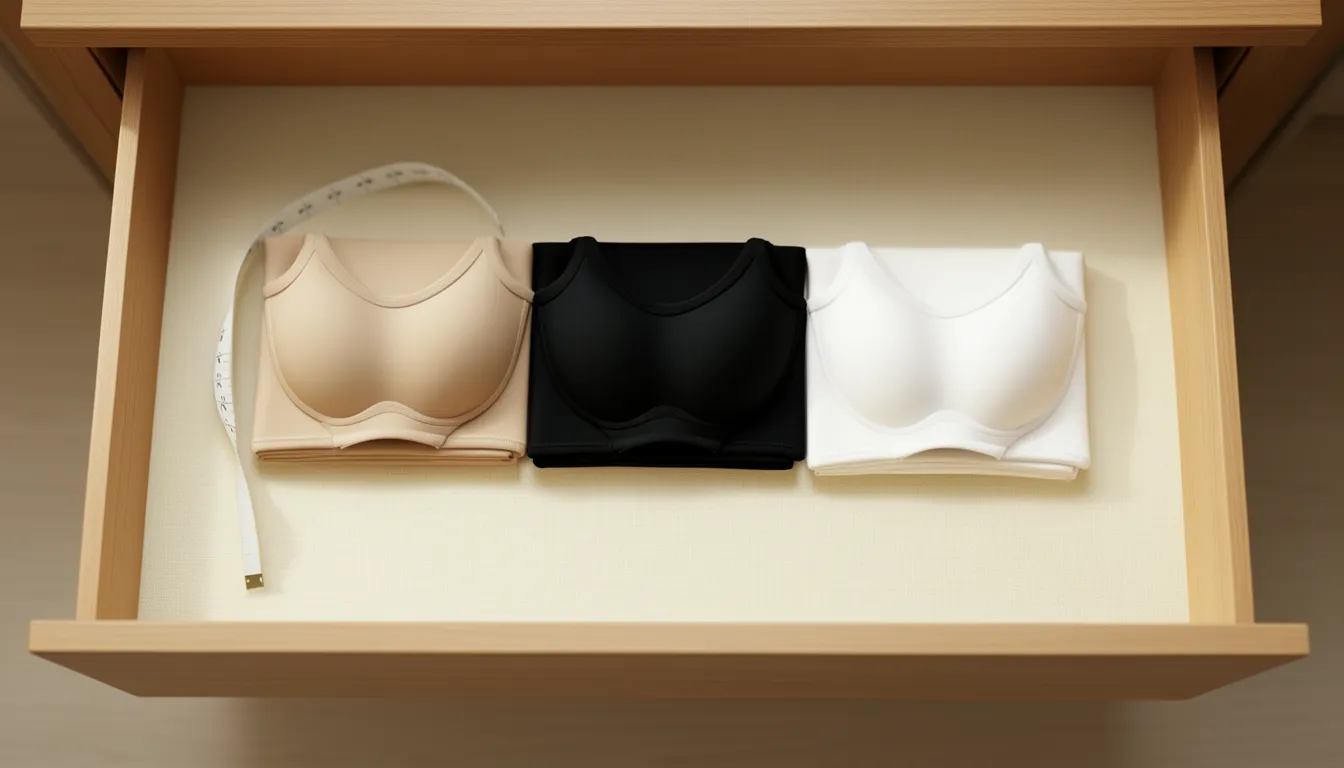
You have your size. Now choose the right shape
A correct size in the wrong shape still fits badly, and the shape decision comes down to what you are wearing over it. Moulded cups hold a fixed rounded shape, which is what makes them invisible under fitted knits and useful for asymmetry; soft cups follow your own shape and are lighter and cooler, but they show more of what is underneath. Cotton breathes and wears comfortably every day; microfibre gives the smoothest line under close-fitting clothes. Colour matters more than people expect — under white or pale fabric, a skin-toned bra disappears where a white one glows. Neckline is the other half of the decision: a scoop, a halter and a mock neck each rule out different straps, which is why our guide to choosing a bodysuit treats neckline and bra as one choice rather than two.
| Style | Sized by | Best for | Under fitted clothes | Watch-out |
|---|---|---|---|---|
| Moulded cup | Band + cup | Everyday wear, asymmetry, smooth line | Excellent — holds its own shape | Fixed shape suits some breast shapes better than others |
| Soft cup | Band + cup | Comfort, warm weather, natural shape | Shows more of what is underneath | Less structure at larger cups |
| Bralette (wire-free) | Letter (S–XL) | Between sizes, low-impact days, sleep | Good, but softer outline | Limited real support above a C cup |
| Clear-strap / multiway | Band + cup | Halter, one-shoulder, wide necklines | Solves visible straps | Clear straps carry less weight than fabric ones |
Three practical picks from our own range across the everyday cases.
For daily wear where breathability wins, a cotton bra with moulded cups in beige and black at €19.99 covers the plain-Tuesday brief. For anything with a tricky neckline — halter, one-shoulder, wide scoop — this microfibre style with clear straps solves a problem rather than adding another bra to the drawer. And if you are chasing a smoother line under fitted clothing generally, the bra is where to spend the effort first: as we argued in our comparison of fashion and shapewear bodysuits, a properly fitted band changes the torso line more than any compression panel will. Browse the full women’s bra collection once you know your number — the triple sizing on every label means you can shop it from any country’s system.
Six mistakes that produce the wrong number
- Measuring over a padded bra. Two to four centimetres of foam is one to two cup letters of error.
- Adding four or five inches to the band. Obsolete advice from the pre-elastane era; it produces a loose band and a small cup every time.
- Pulling the bust measurement tight. Compressed tissue reads smaller, and the cup comes out one or two letters short.
- Treating the cup letter as a volume. A 32D and a 40D are not the same size. Always quote both numbers.
- Keeping the same letter across systems. Above a D cup the systems diverge — a UK DD is an EU E, and a UK FF is an EU H. Convert both parts of the size, not just the band.
- Trusting the tape over the mirror. The calculation gives you a size to try. The five fit checks decide whether it was right.
If you take one thing from all of this, make it the band. It carries the support, it is the number most people get wrong, and it is the one measurement worth taking twice before you order anything.
Bra sizing questions, answered
How do I measure my bra size at home?
Measure your underbust snugly and level, directly below the bust — that is your band. Then measure the fullest part of your bust with the tape resting gently. Subtract the first from the second: about 2.5 cm (one inch) of difference equals one cup letter, starting at A. Wear an unpadded bra or none, breathe out normally, and keep the tape parallel to the floor at the back.
What is my EU bra size in UK or US sizing?
They are the same bra with different labels. European bands are your underbust in centimetres rounded to the nearest 5, so EU 70 = UK/US 32, EU 75 = 34, EU 80 = 36. Cups match through D, then diverge: UK uses DD and FF, US uses DD and DDD, EU carries on with single letters. A UK 34E is a US 34DDD and an EU 75F. French bands run 15 higher than EU ones, so FR 90C = EU 75C.
Should I add 4 or 5 inches to my underbust measurement?
No. That rule comes from an era of non-stretch bra fabrics and does not work with modern elasticated bands. Applied today it produces a band that is too loose and a cup that is too small — which is the exact error pattern bra-fitting studies keep finding. Use your actual underbust measurement, rounded to the nearest even inch or the nearest 5 centimetres.
What are sister sizes and when should I use one?
Sister sizes hold the same cup volume on a different band. Going down a band and up a cup letter (34C → 32D) keeps the volume but tightens the ribcage fit; going up a band and down a cup (34C → 36B) does the opposite. Use it when one part of the fit is right and the other is not — typically when the band rides up but the cups feel roomy.
Why isn't a 32D the same size as a 40D?
A cup letter is a difference, not a volume: D means roughly four inches more than the band. A 40D therefore holds noticeably more than a 32D, because the band underneath it is bigger. This is why "I'm a D cup" tells a fitter very little on its own, and why you should always quote both numbers together.
How often should I re-measure?
Every six to twelve months, and sooner after weight change, pregnancy or anything that shifts breast volume. Most bras also last six to twelve months of regular wear before the band elastic relaxes. The clearest signal is being on the tightest hook within a couple of months of buying, or the band creeping up your back during the day.
The calculated size feels too small in the cup. Is the method wrong?
Sometimes yes. Standard tape methods are known to under-read on fuller, softer or lower-sitting busts, and the gap between measured and correct size is widest in women with larger breasts. Take a second bust measurement leaning forward at about 90 degrees, use the larger reading, and start with a style cut for fuller cups — deeper cup, wider wire — rather than only going up a letter in a standard shape.