

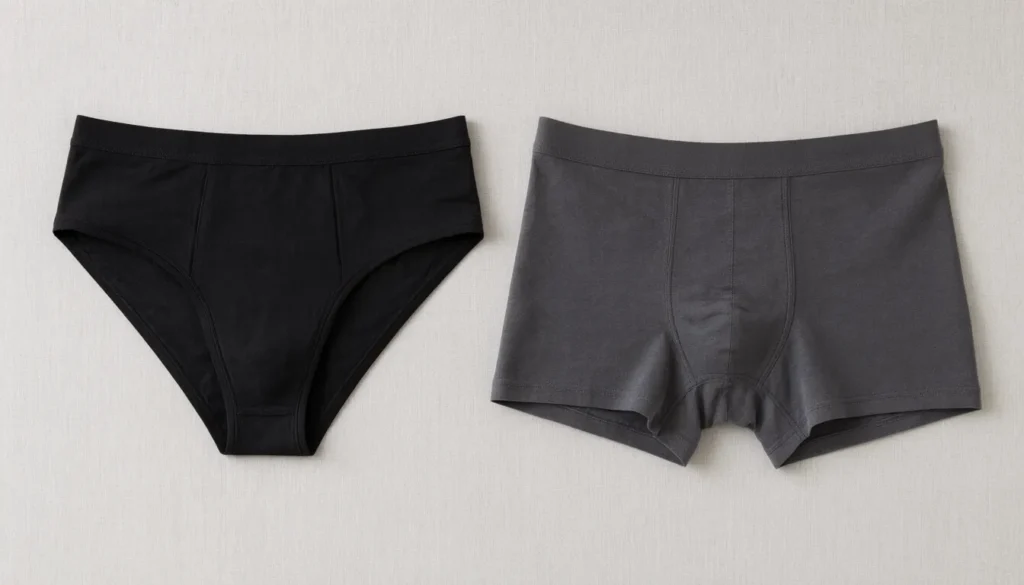
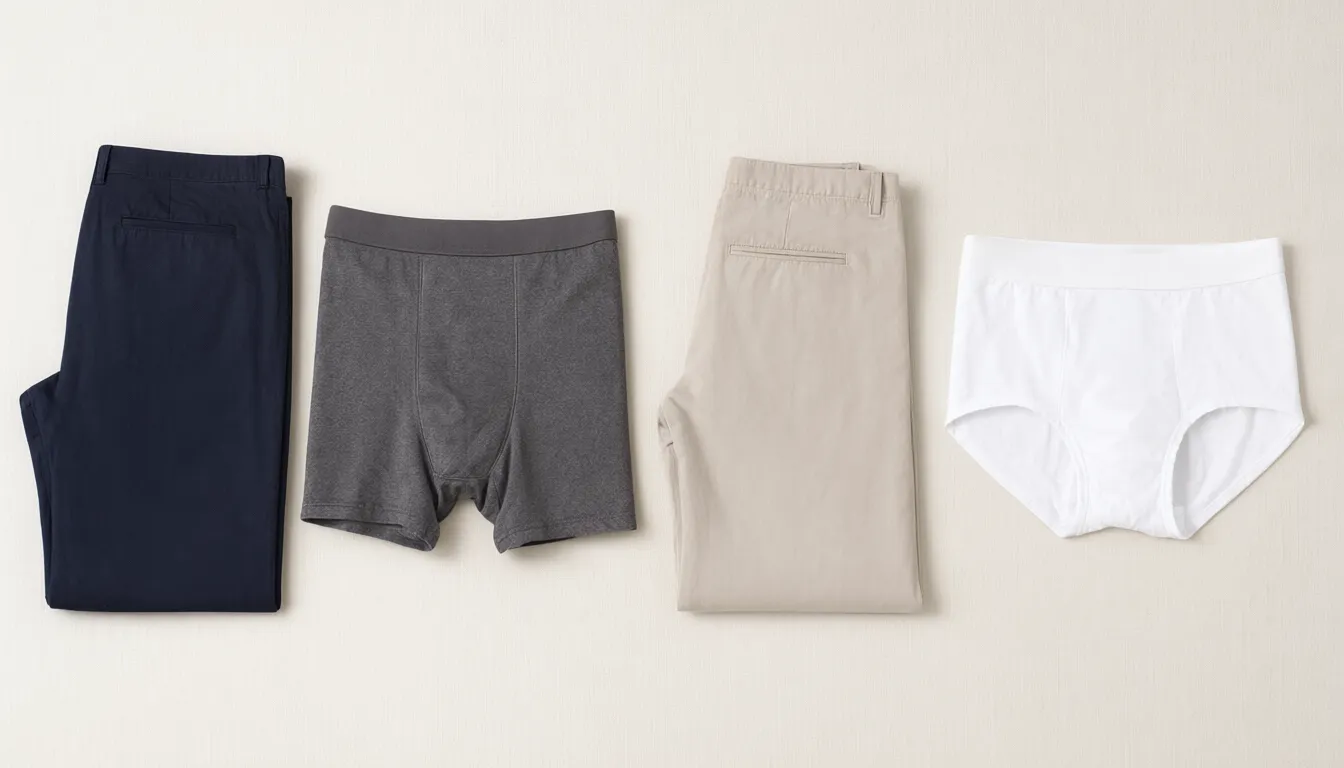
Lay a pair of briefs flat on a table, put a pair of boxer briefs on top of it with the waistbands level, and look at what does not line up. The waistband matches. The front panel, the pouch and the seat cover roughly the same ground. The difference sits lower down: where the brief’s leg opening curves up towards the hip, the boxer brief carries on as a short tube of fabric around the top of each thigh. That strip, a few centimetres of knit on each leg, is the whole argument between the two cuts, and almost everything a man notices about his underwear during the day traces back to it.
Those few centimetres decide whether the opposite thigh rubs skin or fabric on a long walk, whether there is an edge across the seat to show under slim trousers, whether there is a hem down the thigh that can creep upwards, and how much fabric sits around the body on a warm afternoon. Fabric, waistband and size matter too, but the core of it is simple: choosing between briefs and boxer briefs is choosing where you want the leg opening to be.
We are the team that designs, cuts and grades the underwear we sell, and most of our range is women’s lingerie, swimwear and bodysuits. Our men’s range is small and deliberately plain: cotton-blend briefs and boxer briefs, one microfibre brief, and a few thongs. So we will tell you which cuts we make, which we don’t, where our sizes stop, and when the right answer is something we do not sell. You will also find a decision matrix, a scorecard, a waist-only sizing method, a five-minute fit check and a section for anyone buying for a man as a present.
The short answer: choose briefs if you want the most hold, the least fabric and nothing on the thigh, and you rarely walk far in the heat. Choose boxer briefs if your thighs rub, you wear slim trousers and dislike an edge across the seat, or you spend long days on your feet. Size both by the waist, in centimetres, where the waistband actually sits. If you are trying to conceive and a doctor has suggested loose underwear, neither cut is the loose option: that is woven boxer shorts, which we do not make.
Briefs, boxer briefs, trunks and boxer shorts: what each name means
Men’s underwear names describe two things at once: how far the leg reaches and how close the garment fits. A brief has no leg at all. A boxer brief and a trunk are close-fitting stretch knits with a leg, and differ mainly in how long that leg is. A boxer short is a loose, usually woven garment with a wide leg. Because no standard fixes these names, brands use them loosely, and the same garment can be sold as a trunk by one shop and a short boxer brief by the next.
| Name | Leg | Fit | Typical fabric | Do we make it? |
|---|---|---|---|---|
| Brief | None; the leg opening runs from the crotch up towards the hip | Close, stretch knit | Cotton-elastane jersey or microfibre | Yes, cotton blend (90/10) and one microfibre style (80/20) |
| Trunk | Very short; ends just below the crotch | Close, stretch knit | Cotton-elastane, microfibre | Not as a separate line; our boxer briefs sit at this length |
| Boxer brief | Short to mid-thigh; brands sell anything from very short to long | Close, stretch knit | Cotton-elastane, microfibre, modal | Yes, cotton blend (90/10), short leg |
| Long-leg boxer brief | Down towards mid-thigh | Close, stretch knit | Often technical synthetics | No |
| Boxer short | Loose leg, usually to mid-thigh | Loose, often with a button fly | Woven cotton shirting | No |
| Thong | None; a pouch at the front and a narrow strip or string at the back | Close | Cotton-elastane, microfibre | Yes, a few styles (mostly microfibre) |
Briefs
A brief is close-fitting underwear with a full seat, a shaped front and leg openings that rise from the crotch towards the hip, leaving the whole thigh free. It holds everything closest to the body because the leg opening sits in the crease where the thigh meets the torso. Our briefs are cut from a combed cotton blend of 90% cotton and 10% elastane, with an elasticated waistband that sits flat. In our product photos the leg opening rises steeply towards the hip and leaves a fairly narrow side panel below the waistband. The broadest of them in our range, Men’s cotton-blend briefs in four colors, M–2XL, comes in black, white, anthracite and dark blue.
Boxer briefs, and why ours are trunk length
A boxer brief is a brief with a leg: the same close fit and the same kind of front, plus a short tube of fabric around the top of each thigh. The idea is to combine a brief’s hold with some coverage of the thigh. Across the market, leg length is the main variable. Brands sell boxer briefs with an inside leg of roughly 5–8 cm (often called a trunk), around 10–15 cm (a classic boxer brief) and 18–23 cm (long-leg styles for sport). Those are common lengths on brand spec sheets, not a standard and not measurements of our products.
Our boxer briefs sit at the short end. In our own product photos the leg ends a short way down the thigh, so it covers the top of the thigh at the side and back and only a little of the inner thigh. Many shops would call this length a trunk, which is a marketing name for a short-leg boxer brief rather than a separate construction; the leg measurement tells you more than either word. We do not currently publish an inside-leg measurement on the size chart; if the exact length matters to you, ask us and we will measure a pair flat. The everyday version is our cotton boxer briefs in four colours, M to 2XL, 90% cotton and 10% elastane. The rest of the cut, in more colours, is in our boxer briefs.
Boxer shorts
Boxer shorts are loose underwear shorts, usually cut from woven cotton like a shirt, with a wide leg and an elasticated waist. They do not hold anything close to the body. Their advantage is air and room, and their drawback is that loose fabric bunches under slim trousers and twists between the thighs when you walk. We do not make boxer shorts. That matters later, in the section on heat and fertility, because the research that compares “boxers” with tighter underwear is largely about this loose garment, not about boxer briefs.
Thongs, and what else we leave out
A men’s thong has a shaped front pouch and a narrow strip or string at the back instead of a seat. Men who choose one usually want no edge at all under close-fitting trousers, or simply prefer the feel. We make a few, mostly in microfibre (80% polyamide, 20% elastane): three with a pouch, a thin waistband and a string back, and one with a wider waistband and a narrow fabric back, Men’s microfiber thong in black, L–2XL. Stock is thin, often one piece per size, so check before you plan around it. We do not make jockstraps, briefs with an internal pouch or sling, or long-leg sports underwear.
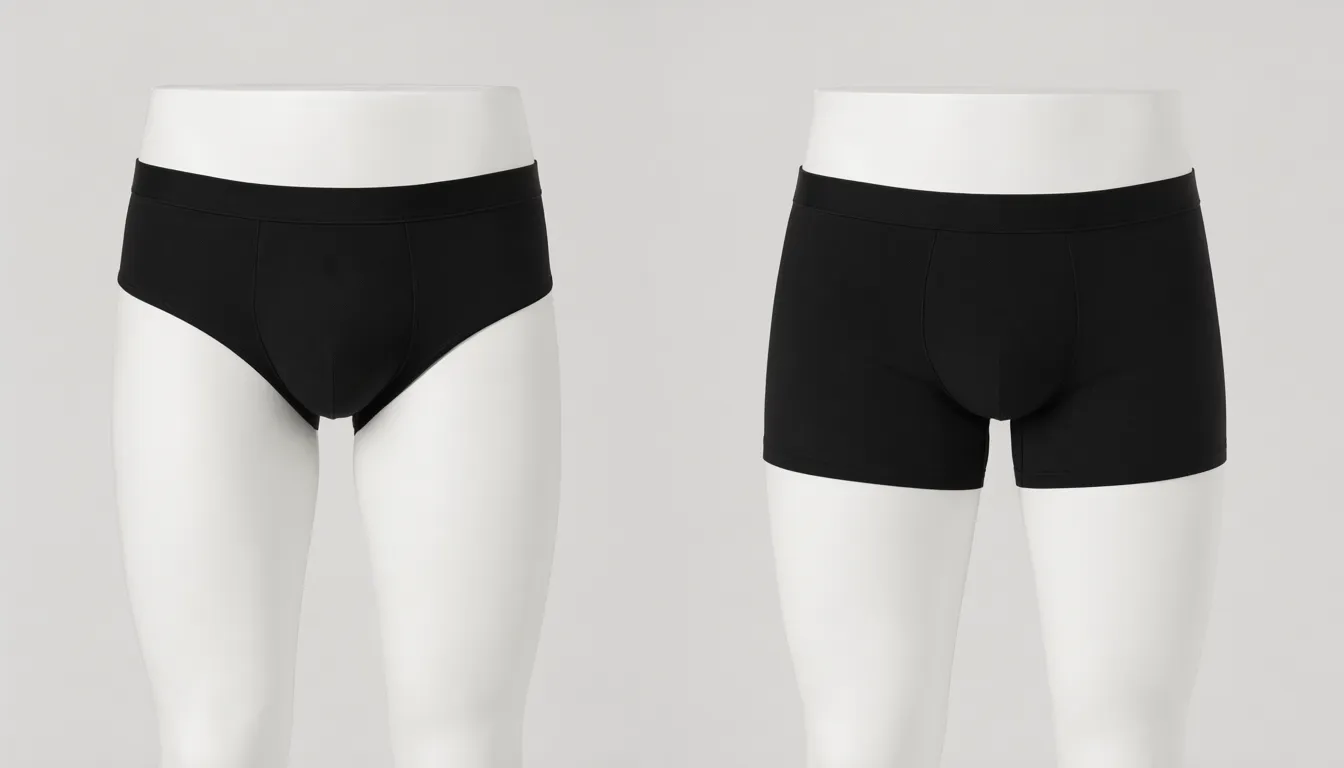
Leg length: the measurement that changes ride-up, chafing and lines
Leg length, measured on the inside seam from the crotch to the hem, is the dimension that separates briefs from boxer briefs, and it drives three common complaints: legs that ride up, thighs that chafe and lines that show under trousers.
Ride-up: why boxer brief legs climb, and briefs don’t
Ride-up is the hem of a boxer brief working its way up the thigh during the day until the leg sits bunched in the crease. It happens because, with every stride, the opposite thigh drags across the outside of the leg. If the hem holds its own thigh less firmly than the other thigh pulls it, it climbs a little with each step. The thigh is also a cone rather than a cylinder, wider at the top than lower down, so a hem that slips upwards meets more thigh and has nowhere to go but into a fold.
A brief cannot ride up the thigh because it has no leg on the thigh: the leg opening already sits in the crease. Its equivalent problem is the seat creeping inwards, which happens when the brief is too small or the leg opening is cut too high for the wearer. So ride-up is the price of thigh coverage. A boxer brief resists it in three ways: a hem with a firm but comfortable grip, a smooth outer surface that the other thigh slides over, and a leg short enough that it has little distance to travel. A short leg like ours has less room to climb than a long one. It also covers less of the thigh, which is the trade-off.
Size matters here too: a boxer brief that is too big has a loose hem the other thigh can push around, and one that is too small grips so hard that the hem rolls outwards.
Chafing: the top of the thigh is where men rub too
Chafing is skin irritation from repeated rubbing, either skin against skin or skin against clothing, and the inner thighs are one of the places it typically happens, as the US National Library of Medicine’s MedlinePlus entry on chafing describes. It is often treated as a women’s problem. It is not. We checked the male half of the largest public body-measurement dataset we know, the ANSUR II anthropometric survey of 4,082 US Army men measured in 2010–2012. The median thigh circumference at the top of the thigh is 62.4 cm (5th to 95th percentile 53.2–72.3 cm), against a median hip breadth of 34.4 cm. In a deliberately crude model that treats each thigh as a round cylinder, the two thighs together are wider than the hips for 98.9% of the men. Real thighs are oval and soft, and this is a military sample, not a European civilian one, so it illustrates rather than measures. But it shows why the tops of the thighs meet on almost every body.
Moisture makes it worse. In laboratory tests at the Swiss materials institute Empa, Gerhardt and colleagues (2008) found that friction between skin and fabric rose in a straight line with skin moisture; going from very dry to normally moist skin raised it by about 26% in men, and a completely wet fabric more than doubled it. A hot day, a long walk or a humid commute turns contact that is harmless at breakfast into rubbing by mid-afternoon.
This is where the boxer brief earns its place. With a brief, the inner thighs are bare and meet skin on skin. With a boxer brief, the top of each thigh is covered, so the contact there is fabric on fabric, which slides more easily. Our short leg covers the very top of the inner thigh, which is where the pressure is greatest, since the thigh is widest there; in the ANSUR data the median male thigh runs about 35.7 cm from the crotch down to the middle of the kneecap, so contact that reaches a third of the way down needs a leg longer than ours. If you chafe further down on long summer walks, a longer-leg boxer brief or a pair of light cycling-style shorts from a sports brand will do more than any underwear we make. We are also preparing a separate, detailed guide to thigh chafing.
Lines under trousers
A visible line is the edge of the underwear printing through the trousers, and the two cuts put their edges in different places. A brief’s leg opening runs diagonally across the seat, so under slim, thin or light-coloured trousers it can show as two curves across the back. A boxer brief has no edge on the seat at all; its edges are the waistband and the hems on the thighs, and under most trousers the hem is invisible because the trouser leg is looser there than the seat is. Under very thin, very close-fitting trousers, a horizontal hem line on the thigh can show instead.
So under slim jeans and chinos the boxer brief usually gives the cleaner line. Under thin summer trousers colour matters as much as cut: dark underwear shows through white or pale fabric even when no edge does, so choose white or light grey (we do not make a skin-tone men’s pair). And if no line at all is the goal, a thong is the only cut with no edge on the seat or the thigh.
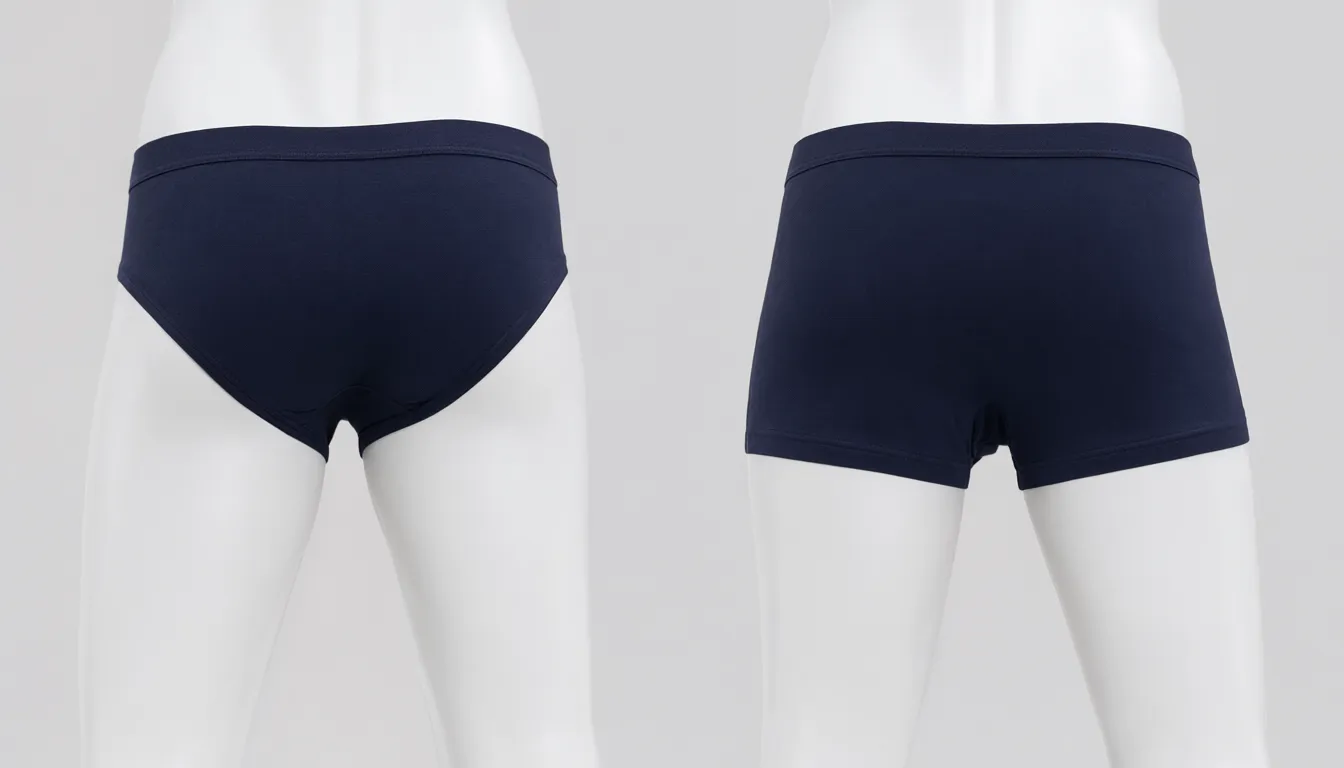
Support and the pouch: what actually holds things in place
Support in men’s underwear means holding the genitals close to the body so they do not swing or shift when you walk, sit or move, and it comes from three parts working together: the shape of the front panel, the stretch of the fabric, and the position of the leg openings. Neither cut has a monopoly on it. A brief and a boxer brief cut from the same fabric, with a similar front, hold in a similar way.
The front panel is the first part. Most close-fitting men’s underwear, ours included, has a front shaped with seams so that it curves outwards and forms a pouch rather than lying flat. In our product photos the briefs have a contoured front panel and the boxer briefs a front shaped by two curved seams. A flat front squashes; a shaped front holds. The second part is the fabric. Our cotton blend has 10% elastane and our microfibre 20%, and it is the elastane that makes the knit spring back and keep a gentle, even pressure on the body. The third part is the leg opening. On a brief, the opening sits in the crease at the top of the thigh and closes the pouch from below. On a boxer brief, the leg tube does the same job lower down, and on our short leg that is close to where a brief’s opening would be anyway.
Many men still feel that briefs hold more, because the brief’s opening sits right at the crease with nothing below it to move, while a boxer brief’s leg moves with the thigh. It is a real difference in feel, but a small one in a well-fitted pair. Size changes support far more: a pair that is too big, in either cut, holds nothing.
One honest limit: everyday underwear is not sports equipment. Contact sports call for a cup in a jockstrap or compression shorts made for it; runners and cyclists do best in purpose-made shorts, and padded cycling shorts are designed to be worn without underwear at all. Ours are for everyday wear, walking and the gym, and we make no medical claims for either cut.
The waistband: width, rise and why some roll
The waistband is the part of men’s underwear that decides whether the rest stays where it should, and the three things that matter are its width, how it is finished and how high it sits. A waistband that slides down drags the whole garment with it: the pouch drops, the seat sags and the legs of a boxer brief slip into the crease.
- Width. A wider band spreads its pressure over more skin, so it can hold firmly without cutting a line into the waist. A narrow band has to grip harder to hold the same weight of fabric and is more likely to roll over under a belly or after sitting.
- Finish. Some bands are a strip of elastic covered in the same fabric as the body; others are an exposed knitted elastic, sometimes in a contrast colour. Covered bands feel softer and lie flatter under a T-shirt. Exposed bands show more and are often wider. Our range has both. Most of our pairs have a flat, self-fabric band; a few, such as the briefs with a wide black waistband in black, anthracite and dark blue, use a broader contrast band. In the photos all our bands are plain, without lettering, which some men prefer under a white shirt.
- Rise. The rise is how high the waistband sits relative to the navel. Most briefs and boxer briefs, ours included, sit a little below the navel, across the top of the hip bones. A lower rise feels freer but is more likely to slip; a higher rise holds better but can sit above a low trouser waistband and show.
A waistband rolls when the body under it is a slope rather than a wall, typically on a belly, and a size that is too small makes it worse: the tighter the band, the harder the slope pushes it over. The fixes, in order: check the size against the girth where the band sits, then try a wider band or a slightly higher rise. Going down a size does the opposite.
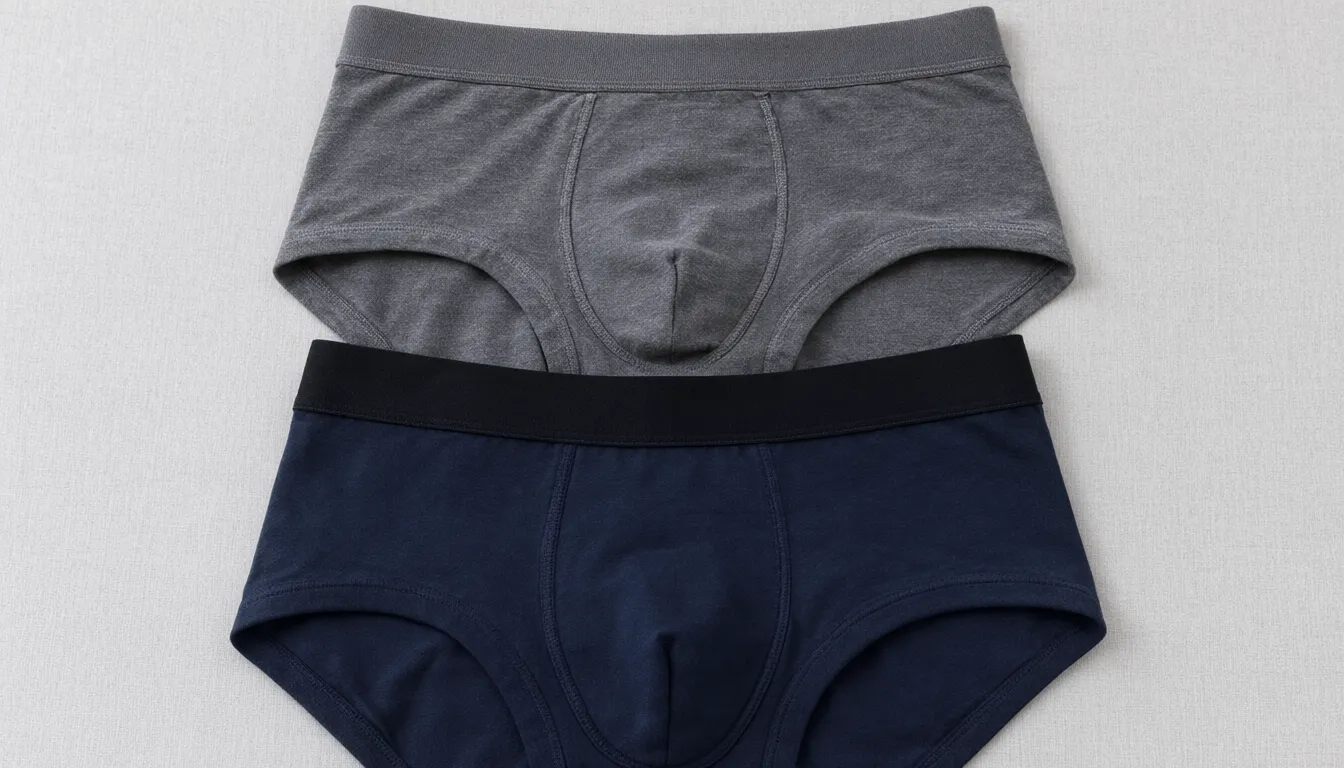
Fabric: our cotton blend versus microfibre
The fabric of men’s underwear decides how it feels, how much sweat it holds and how it looks under clothes, and in our range there are two: a combed cotton blend of 90% cotton and 10% elastane, used for almost every brief and boxer brief, and a microfibre of 80% polyamide and 20% elastane, used for one brief and most of our thongs. Those compositions come from the “The Fabric” block on each product page. We do not make modal, bamboo-viscose or merino men’s underwear, and we will not claim properties for our fabrics that the product data does not state.
The most useful official comparison of how much water different fibres take up is the table of “agreed allowances” in the EU textile labelling regulation, Regulation (EU) No 1007/2011, Annex IX. These are the conventional moisture regain figures used in trade: the share of a fibre’s dry weight it holds as water in a standard atmosphere. They are not a sweat test, but they point in the right direction.
| Fibre or blend | Agreed allowance (EU 1007/2011, Annex IX) | What it means against the skin |
|---|---|---|
| Cotton | 8.5% | Absorbs readily; soft and matt; slow to give the water back |
| Polyamide (nylon) filament | 5.75% | Takes up less; smooth, slightly cool surface |
| Elastane | 1.5% | Barely absorbs; there for stretch and recovery |
| Our cotton blend, 90/10 (weighted) | ≈ 7.8% | All our cotton briefs and boxer briefs, and one thong |
| Our microfibre, 80/20 (weighted) | ≈ 4.9% | Our microfibre brief and microfibre thongs |
On those numbers our cotton blend holds roughly 60% more water than our microfibre in normal air. Cotton feels soft and natural when you are dry and holds on to moisture on a hot day; microfibre feels smoother and cooler, lies flatter under trousers and gives water back sooner, but some men find it less pleasant on the skin, and synthetics can hold odour more stubbornly.
| Cotton blend (90% cotton, 10% elastane) | Microfibre (80% polyamide, 20% elastane) | |
|---|---|---|
| Feel | Soft, matt, familiar | Smooth, slightly cool, sleek |
| Under slim trousers | Very good; slightly thicker | Excellent; thinner and slides under fabric |
| Hot day, long walk | Holds sweat once damp | Holds less, gives it back sooner |
| Stretch and recovery | Good (10% elastane) | More stretch (20% elastane) |
| Odour after a long day | Usually washes out easily | Can cling more; wash every wear |
| In our range | Nearly all briefs and boxer briefs, M–2XL | One brief (L) and three thongs |
Our microfibre option in briefs is one style, the microfibre briefs in black, and at the time of writing it is available in size L only. If you want microfibre in another size, the honest answer is that we do not have it right now. We do not make microfibre boxer briefs at all; every boxer brief we sell is the 90/10 cotton blend.
Heat, sperm and underwear: what the research actually shows
The research on underwear and male fertility shows a consistent link between a warmer scrotum and lower semen quality, a modest association between tight underwear and some semen measures in observational studies, and no clear effect of underwear type on how quickly couples conceive. That is a more careful answer than either “briefs harm fertility” or “it makes no difference”, and it is the one the NHS gives: there is a link between increased scrotal temperature and reduced semen quality, “but it’s uncertain whether wearing loose-fitting underwear improves fertility” (NHS, causes of infertility).
The testicles sit outside the body because sperm production works best a few degrees below core temperature. The question is how much underwear moves that temperature compared with the rest of a man’s day. These are the studies most often quoted.
| Study | Who and how | What it found | How much weight to give it |
|---|---|---|---|
| Munkelwitz and Gilbert, 1998 | 97 men at a fertility clinic; scrotal temperature measured; 14 swapped underwear type | Mean scrotal temperature 33.8 °C in boxer wearers and 33.6 °C in brief wearers; no significant difference, also after swapping | Small, but measured temperature directly |
| Hjollund and colleagues, 2002 | 101 men wore a temperature logger on their underwear for 24 hours | Sitting at work mattered most: median 33.1 °C with under 1 hour sedentary work, 34.7 °C with over 6 hours; no effect of reported underwear tightness | Real-life measurement; shows how much posture matters |
| Jung and colleagues, 2005 | 50 healthy volunteers, standardised sitting and walking in a 20 °C room | Scrotal temperature was higher in tight than in loose underwear, and higher in loose than in none; walking was cooler than sitting | Controlled; shows tight versus loose, not brief versus boxer brief |
| Sapra and colleagues, 2016 | 473 men in couples trying to conceive, followed for up to 12 months | A few semen differences by underwear habit, none significant after correction for multiple testing; no difference in time to pregnancy | Prospective; the outcome couples care about |
| Mínguez-Alarcón and colleagues, 2018 | 656 men attending a fertility centre; self-reported underwear | Men who mostly wore boxers had 25% higher sperm concentration, 17% higher total count and 14% lower FSH than men who mostly wore tighter styles | A large clinic study; cross-sectional, fertility-clinic men only |
| McKinnon and colleagues, 2022 | 3,041 couples trying to conceive | Little association between tight-fitting underwear and the chance of conceiving per cycle; hot baths and fever showed weak links | Large, prospective, pregnancy as the outcome |
| Zleczewski and colleagues, 2026 | Narrative review of the literature to 2025 | Modest, inconsistent differences in sperm measures; no clear effect on fertility outcomes; underwear choice alone unlikely to change them meaningfully | The most recent summary |
Read together, three points stand out. First, the “boxers” in these studies are mostly loose boxer shorts, compared with tighter underwear of every kind. A boxer brief is a tight garment with a leg, so none of this research says boxer briefs are cooler than briefs; it treats them as the same category. Second, temperature is driven by more than underwear: long hours of sitting, laptops on the lap, hot baths and fever all appear in the literature, and in the Danish logger study sitting at work explained far more of the variation than underwear did. Third, the studies that measured semen found differences, and the studies that followed couples trying to conceive mostly did not.
A very large Chinese clinic study published in 2026 (Hu and colleagues, 26,836 men) again linked self-reported tight underwear to poorer semen measures, but its tight-underwear group also smoked and drank more and had more varicoceles, which shows how hard it is to separate underwear from everything else.
Our practical reading, a judgement and not medical advice: for most men, choose underwear for comfort, and on long seated days, getting up and walking does more for scrotal temperature than changing the cut. If you are trying to conceive and a doctor has raised concerns, loose woven boxer shorts are the option the research points to, and we do not sell them. We make no fertility claims for any of our underwear, in either direction.
Which cut for which day: a decision matrix and a scorecard
The better cut depends less on the man than on the day: what goes over it, how far he will walk and how hot it will be. The picks below are our judgement from fitting and the mechanics above, not a laboratory ranking.
| Situation | Our pick | Second choice | Why |
|---|---|---|---|
| Slim jeans or chinos, office day | Boxer brief | Brief | No edge across the seat; the hem disappears under the looser trouser leg |
| Thin, light or white summer trousers | Brief or boxer brief in white or light grey | Thong | Colour shows before cut does; we have no skin-tone pair |
| Shorts | Brief | Short-leg boxer brief | Nothing to peek out below a short trouser leg |
| Long walking day or city break in heat | Boxer brief | Brief with a spare pair | Fabric between the thighs instead of skin; change once damp |
| Gym and weights | Boxer brief or brief | — | Do ten squats in them first: a hem that creeps now will creep all session |
| Running | Purpose-made running shorts | Microfibre brief | Technical fabric and flat seams; our cotton holds sweat |
| Cycling | Padded cycling shorts, no underwear | — | The pad is designed to sit against the skin |
| Long flight or drive | Boxer brief | Brief | Stand and walk when you can; sitting warms more than underwear does |
| Hot, humid climate | Microfibre brief | Cotton boxer brief on short days | Less water held against the skin |
| Winter, under wool trousers | Boxer brief | Brief | Covers the top of the thigh against scratchy cloth |
| Suit with slim tailoring | Boxer brief | Thong | Clean line at the seat |
| Sleeping | Loose shorts or nothing | — | No reason to hold anything close at night |
| Trying to conceive, with a doctor’s advice | Loose woven boxer shorts | — | The loose option in the research; we don’t make it |
And here is the same comparison as a scorecard, with boxer shorts included so you can see what each cut gives up. Scores run from 1 (weak) to 5 (strong) and are our own assessment of a well-fitting pair, not test results.
| Brief | Boxer brief (short leg) | Thong | Boxer shorts (we don’t make) | |
|---|---|---|---|---|
| Thigh coverage against chafing | 1 | 3 | 1 | 2 |
| Stays put through the day | 4 | 3 | 4 | 2 |
| Clean line under slim trousers | 3 | 4 | 5 | 1 |
| Hold and support | 5 | 4 | 4 | 1 |
| Air and room | 2 | 2 | 3 | 5 |
| Forgiving between sizes | 4 | 3 | 4 | 5 |
No cut wins every row, which is the point. Many men end up with both in the drawer: boxer briefs for slim trousers and long days, briefs for shorts, the gym and evenings.
Sizing men’s underwear: one measurement, in centimetres
Men’s underwear is sized by a single body measurement, the waist girth, and that is not our shortcut but the European standard: EN 13402-2 lists waist girth as the primary dimension for men’s underpants, the same measurement it uses for men’s trousers. Our size chart, which appears in the photo gallery of every men’s underwear product, uses one waist range per letter for briefs, boxer briefs and thongs alike.
| Size | Waist (cm) | Waist (in) | Briefs and boxer briefs in our range |
|---|---|---|---|
| S | 68–76 | 26.8–29.9 | Not currently made in S |
| M | 76–84 | 29.9–33.1 | Yes |
| L | 84–92 | 33.1–36.2 | Yes |
| XL | 92–100 | 36.2–39.3 | Yes |
| 2XL (XXL on the chart) | 100–106 | 39.3–41.7 | Yes |
How to measure
- Stand relaxed, breathing out normally, in your underwear or nothing.
- Find where the waistband of the underwear you wear most often sits, usually just below the navel and across the top of the hip bones. That is the girth that matters, not your natural waist higher up.
- Run a soft tape around at that height, level all the way round. Keep it snug against the skin without pressing in.
- Read the result in centimetres and find the row on the chart.
Between two sizes
Our chart shares its boundaries: 76 cm ends S and starts M, 84 cm ends M and starts L, and so on. If you measure on a boundary or within a centimetre of one, we suggest the larger size for boxer briefs, because the leg hems also have to fit the thighs, and either size for briefs, chosen by feel: the smaller holds more firmly, the larger feels freer. For a gift, go up. Being near a boundary is common: applied to the ANSUR II men (measured at the navel, so only a rough guide to where a waistband sits), about a quarter of those within our chart fall within 1 cm of a size boundary.
Where our range stops
Our briefs and boxer briefs run from M (76 cm) to 2XL (106 cm). Again using ANSUR II only as an illustration, roughly 15% of the US Army men measured more than 106 cm around the navel, beyond our largest size, and about 4% measured less than 76 cm. A waistband below the navel often measures less, so measure yourself. Above 106 cm where the band sits, our underwear will be too small, and a brand with 3XL and above is the better buy. Our chart gives no inside-leg, rise or thigh measurement; ask us if you need one.
A five-minute fit check
A good fit in men’s underwear means the waistband lies flat without marking, the front holds without pressing, the seat is covered without bagging, and the legs or leg openings stay where they started after you move. You can check all of it in five minutes, ideally before removing the tags.
- Waistband: flat all the way round, no rolling at the front when you sit, and you can slide two fingers under it without effort.
- Front: holds everything close without flattening; no gap at the top of the pouch.
- Seat: covered smoothly; the fabric does not wedge inwards (too small) or hang in folds (too big).
- Leg openings of a brief: sit in the crease without cutting into the thigh or gaping.
- Hems of a boxer brief: lie flat on the thigh, without rolling outwards or leaving a deep mark.
- Movement test: ten deep squats or two flights of stairs, then sit for a few minutes. Anything that has crept, rolled or twisted now will be worse by the evening.
| What you notice | Usual cause | Fix |
|---|---|---|
| Waistband rolls over at the front | Too small for the girth where the band sits, or band too narrow | Re-measure at band height; a size up or a wider band |
| Boxer brief legs ride up into the crease | Hem too loose (too big), or a long day with damp skin | Check the size; a pair with a firmer hem; brief on short-trouser days |
| Hems roll and leave a red line | Too small | One size up |
| Seat wedges inwards | Too small, or leg openings cut too high for you | One size up, or a boxer brief |
| Pouch feels loose or things shift | Too big | One size down, if the waistband still lies flat |
| Edge shows under trousers | Brief leg opening on the seat, or dark colour under light fabric | Boxer brief under slim trousers; a lighter colour under pale fabric |
How many pairs, and when to replace them
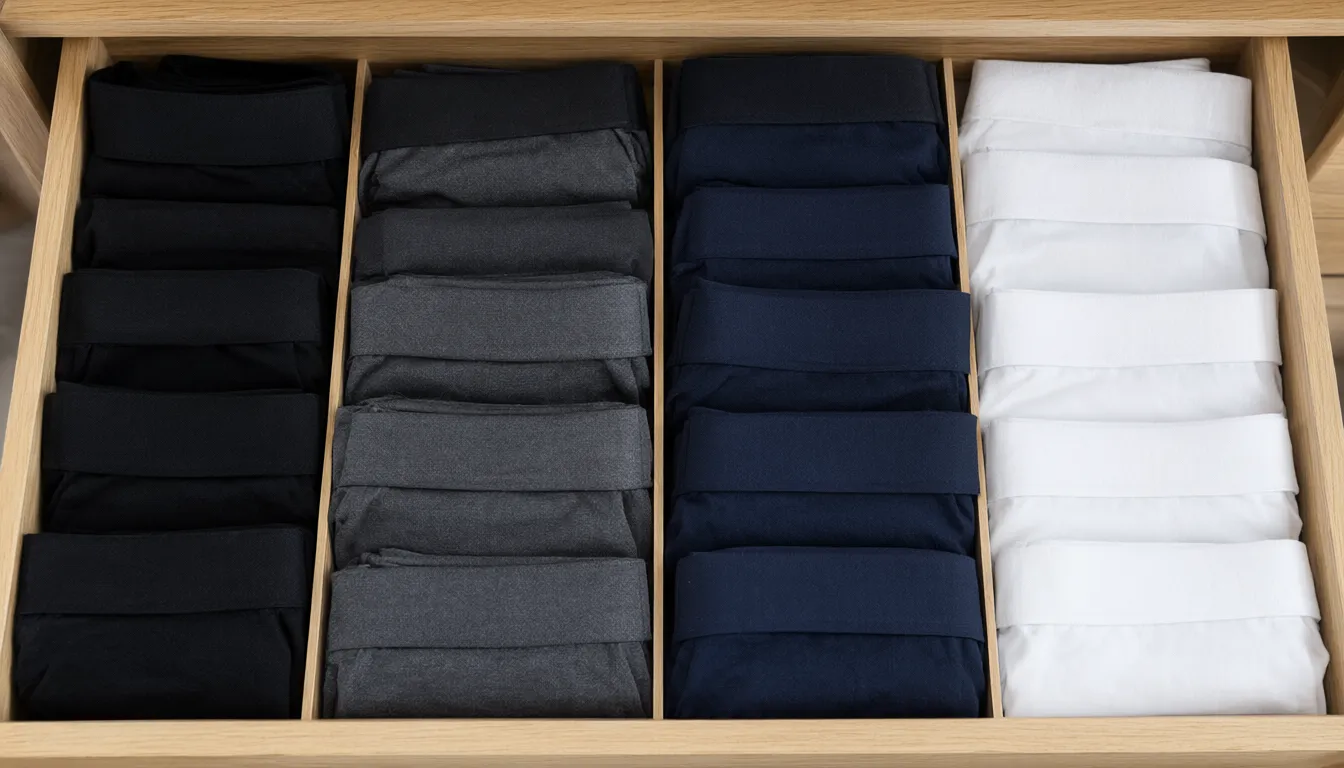
The number of pairs you need is set by how often you do the washing, because underwear should be washed after every wear. If you wash once a week, seven pairs is the bare minimum and nine or ten is comfortable, so a delayed wash or a gym day does not leave you short. If you wash twice a week, five or six plus a spare is enough.
Replace a pair when it stops doing its job, not by the calendar. The signs: a waistband that ripples, rolls or has lost its grip; leg hems or openings that wave instead of lying flat; fabric that has thinned, pilled or gone grey; and a stale smell that survives a proper wash. We are preparing a separate guide to how long underwear really lasts, piece by piece, so here we will leave it at that.
Care in one paragraph
Wash men’s underwear after every wear, on a 30 or 40 °C cycle for our cotton blend and a cooler, gentler cycle for microfibre, always within what the care label on the garment allows, since our product pages give the composition but not care instructions. Skip fabric softener: it coats the fibres and makes cotton absorb less. Avoid the tumble dryer and the radiator if you want the waistband to last, because heat is what ages elastane fastest, and elastane is what holds the waistband and the legs in shape. Dry flat or on a line, and wash new dark pairs with similar colours the first few times.
Buying for him: getting the size right without asking
Men’s underwear is one of the easier clothing gifts to size, because it depends on one measurement and that measurement is printed inside most of his trousers. Under EN 13402 men’s trousers and underpants are both designated by waist girth, so the waist number on his trousers is the best clue you can find without a tape.
- Copy the cut he already wears. Look in the laundry rather than at what you think suits him. A man who wears boxer briefs every day rarely switches to briefs because of a present, and the other way round.
- Read his trouser waist. Jeans and chinos usually carry a W number in inches, such as W32. Multiply by 2.54 for centimetres and read our chart (table below). Trousers usually sit at about the same height as underwear, which is why this works better than a shirt size.
- Cross-check with his current underwear. The letter on his favourite pair (M, L, XL) should agree with the trouser estimate. If it doesn’t, trust the underwear letter, and if the two point to neighbouring sizes, go up.
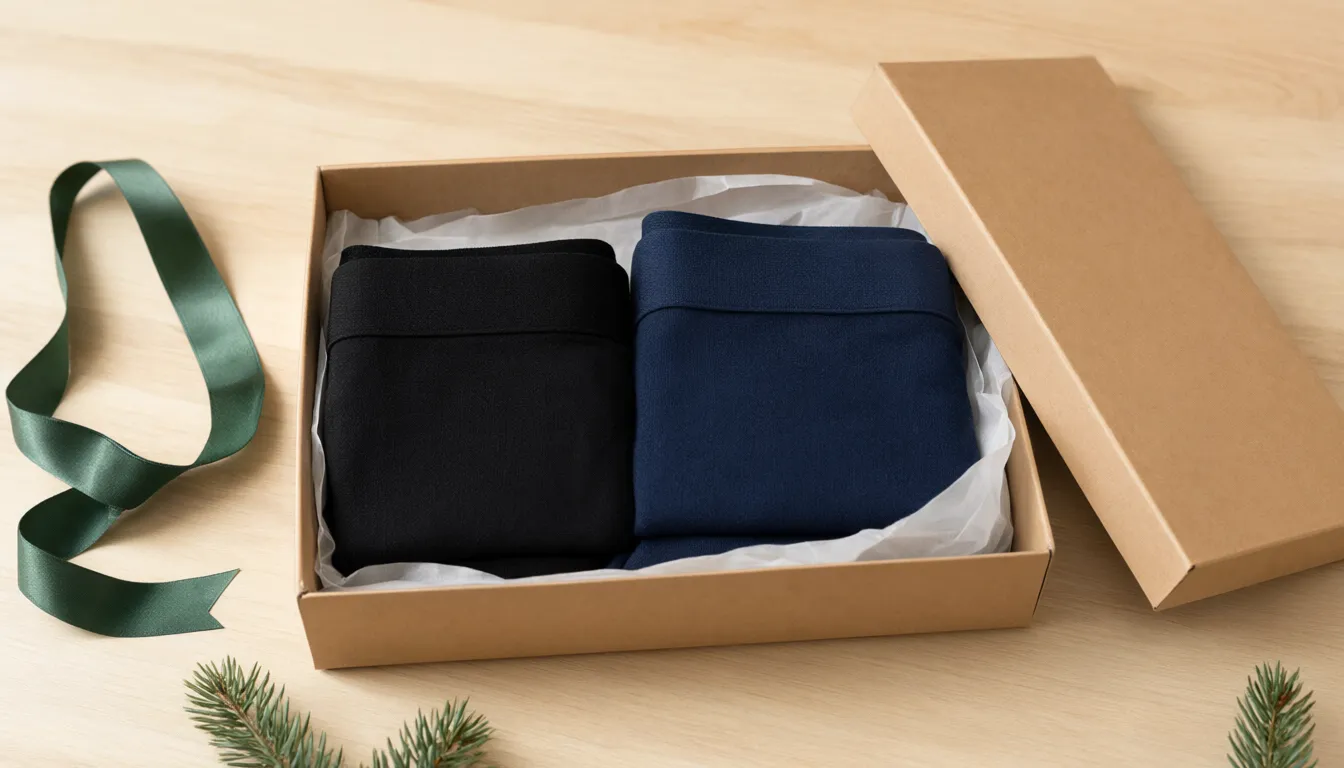
- Choose colours from his drawer. Black, anthracite and dark blue are the safe choices; a brighter pair works as a second one, such as this pair in red, black and anthracite.
- Leave the tags on. Our 30-day exchange window starts on delivery, not on the day he opens it, and pieces must be unworn with tags attached.
| Trouser waist label | In centimetres | Our size |
|---|---|---|
| W28–W29 | 71–74 | S (we don’t make S in briefs or boxer briefs) |
| W30 | 76 | M (on the S/M boundary) |
| W31–W32 | 79–81 | M |
| W33 | 84 | M/L boundary: L for boxer briefs |
| W34–W35 | 86–89 | L |
| W36 | 91 | L, close to XL |
| W37–W38 | 94–97 | XL |
| W39–W41 | 99–104 | XL on the boundary, otherwise 2XL |
| W42 and above | 107+ | Above our range |
If the same list has a woman on it, lingerie is a different problem with different risks, and we have written a full guide to buying lingerie as a gift without asking her size, including when to order so that the exchange window runs past Christmas. If she would rather measure herself for a bra, our bra size guide in centimetres walks her through it.
Who should choose briefs, and who should choose boxer briefs
Briefs suit men who want the firmest hold with the least fabric, and boxer briefs suit men who want their thighs covered and no edge across the seat. Most of the decision comes down to trousers, thighs and the kind of day ahead.
| Briefs | Boxer briefs | |
|---|---|---|
| Pros | Most hold; nothing on the thigh to ride up; least fabric; fine under shorts; forgiving between sizes | Covers the top of the thigh; no edge on the seat; clean under slim trousers; softer feel on long days |
| Cons | Bare inner thighs can chafe; leg edge can show across the seat under thin trousers | Hems can ride up or roll; the leg must fit the thigh as well as the waist; more fabric in heat |
| Choose them if | You like a close hold, wear shorts or loose trousers, or your thighs never rub | Your thighs rub, you wear slim jeans or chinos, or you walk a lot |
| Think twice if | You walk far in heat, or dislike a line on the seat | You wear short shorts, or every boxer brief you have tried has ridden up |
Neither is the right choice for running, cycling, contact sports or sleeping, and neither is the loose option if a doctor has advised loose underwear. For everyday life, start with our men’s underwear range: both cuts in the same cotton blend, from M to 2XL, so you can try one of each and let a week of ordinary days decide. If you already know you prefer the closer cut, go straight to our briefs.